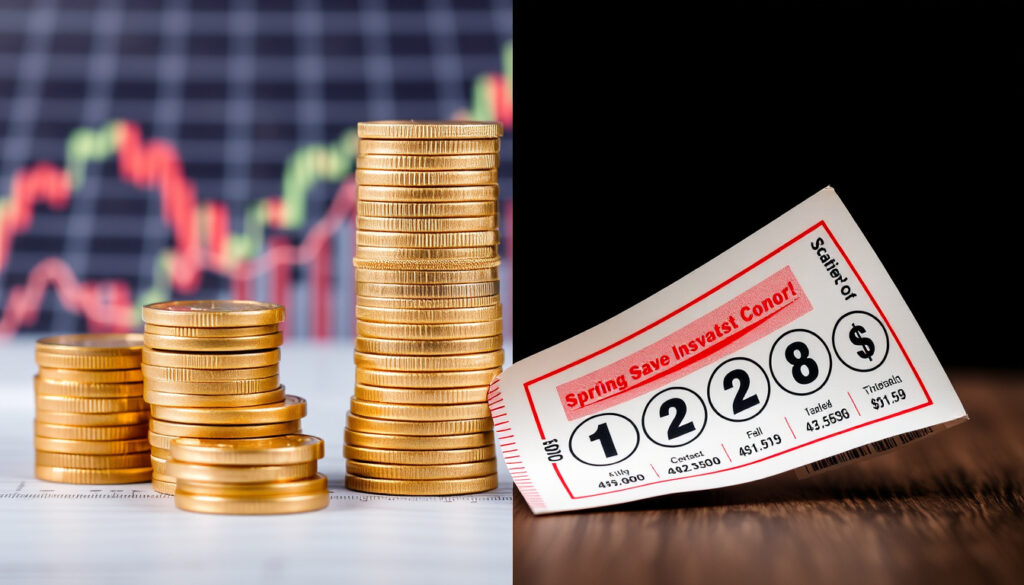
Investment vs Lotto Odds: Which Builds Real Wealth
Placing a £2 bet on the UK Lotto is a moment of hope; investing that same £2 in the stock market feels more like a chore. Yet when you zoom out over decades, those two choices diverge into radically different outcomes. This article breaks down the actual numbers behind UK lottery odds versus the maths of long-term compound returns, so you can see exactly what your money is — and isn’t — doing.
Odds of winning UK Lotto jackpot (per line): 1 in 45,057,474 ·
Odds of being struck by lightning (lifetime): 1 in 15,300 ·
Average annual stock market return (S&P 500, long-term): ~10% ·
Annual lottery spend per average UK player: £260 ·
£5,200 invested over 20 years at 7% return: ~£20,000
Quick snapshot
- UK Lotto jackpot: 1 in 45,057,474 (National-Lottery.com)
- Set for Life top prize: 1 in 15,000,000 (Find The Norm)
- EuroMillions jackpot: 1 in 139,838,160 (Find The Norm)
- Lightning strike (lifetime): 1 in 15,300 (National-Lottery.com)
- £2/week invested for 30 years at 7% grows to ~£11,000 (Investopedia)
- Lottery expected return: ~50% loss per £1 spent (Investopedia)
- Market crash chance: ~10% per decade, but recovers (Investopedia)
- Lottery always has a negative expected value (Investopedia)
- Exact number of lottery winners who go bankrupt is debated; NAPFA’s 70% figure is widely cited but lacks transparent methodology
- Future investment returns are uncertain and depend on market conditions
Six key statistics that frame the entire lottery versus investment debate — one pattern: the lottery’s headline jackpot numbers are astronomically low while its expected value is deeply negative, yet UK players collectively spend hundreds a year chasing them.
| Metric | Value | Source |
|---|---|---|
| UK Lotto Odds (Jackpot) | 1 in 45,057,474 | National-Lottery.com |
| Set for Life Odds (Top Prize) | 1 in 15,000,000 | Find The Norm |
| EuroMillions Odds (Jackpot) | 1 in 139,838,160 | Find The Norm |
| Lightning Strike Odds (Lifetime) | 1 in 15,300 | National-Lottery.com |
| Average Annual S&P 500 Return | ~10% (Nominal) | Investopedia |
Are you more likely to win Lotto or Set for Life?
UK Lotto jackpot odds
- Matching all six numbers from a pool of 59 gives a chance of 1 in 45,057,474 (National-Lottery.com).
- The overall odds of winning any Lotto prize — from a free lucky dip to the jackpot — are roughly 1 in 9.3 (National-Lottery.com).
Set for Life top prize odds
- Set for Life’s top prize — £10,000 a month for 30 years — has odds of 1 in 15,000,000 (Find The Norm).
- The game draws five main numbers from 1–47 and one Life Ball from 1–10.
Probability of winning any prize in each game
- Lotto: 1 in 9.3 for any prize (National-Lottery.com).
- Set for Life: approximately 1 in 12 for any prize.
The implication: Set for Life’s top prize is three times more likely than the Lotto jackpot, but the headline jackpot is still vanishingly rare. Neither game rewards regular play in the way a savings account does.
What is more likely than winning the Lotto?
Lightning strike odds
- Your lifetime odds of being struck by lightning in the UK are 1 in 15,300 (National-Lottery.com).
- That makes you about 2,945 times more likely to be hit by lightning than to win the Lotto jackpot.
Other rare events
- Being killed by a shark: 1 in 3,748,067.
- Becoming a professional athlete: ~1 in 22,000.
- Giving birth to quadruplets naturally: 1 in 729,000.
Random tragic accidents
- Dying from a dog attack: 1 in 112,400.
- Being killed by a falling coconut: 1 in 250,000.
The pattern: virtually every uncommon life event — being struck by lightning, attacked by a dog, or even becoming a pro athlete — is markedly more probable than hitting the Lotto’s top prize. The one thing more likely than winning? Passing the £2 cost of a ticket to an index fund.
A regular £2 Lotto player faces odds of roughly 1 in 45 million for the jackpot, but the same £2 deposited weekly into a global equity tracker fund gives a near-certain probability of having saved more than £11,000 after 30 years — no lightning needed.
Does Lotto have better odds than EuroMillions?
EuroMillions jackpot odds
- EuroMillions jackpot odds are 1 in 139,838,160 (Find The Norm).
- That is roughly 3.1 times harder than winning the UK Lotto jackpot.
Comparison of lower-tier prize odds
- Matching five numbers (no stars) in EuroMillions: 1 in 3,097,351.
- Matching five numbers in Lotto: 1 in 445,851.
- EuroMillions has two “Lucky Star” numbers drawn from 1–12, which significantly steepen the odds for top tiers.
The catch: Lotto is the better option for sheer top-prize probability, but both games share a negative expected value — meaning you lose money on average over time, no matter which you play.
What is the biggest mistake made by lottery winners?
Financial mismanagement
- Roughly 70% of lottery winners reportedly go bankrupt within a few years (NAPFA).
- Many fail to account for taxes, estate duties, and ongoing living costs.
Unrealistic spending
- Common early splurges include luxury cars, holiday homes, and gifts for relatives that cannot be sustained.
- Winners often quit their jobs and lose a steady income stream alongside the prize money.
Lack of professional advice
- Winners who fail to hire independent financial and legal advisors tend to make the worst decisions.
- One UK winner lost £1.5 million in business ventures within two years of winning £3 million.
A UK lottery winner who follows a disciplined long-term strategy can turn a windfall into generational wealth. The 70% who go broke demonstrate that large sums of money amplify a person’s existing habits — good or bad.
How much do you take home if you win $1,000,000?
US tax withholding on lottery winnings
- Federal withholding is 24% up front.
- Top marginal rate can reach 37% depending on total income bracket.
- State taxes vary from 0% (Florida, Texas) to over 8% (New York).
Lump sum versus annuity
- Lotteries advertise the “annuity” value — a $1 million jackpot is typically paid over 30 years.
- Taking a lump sum gives about half: roughly $500,000 before taxes.
- After federal withholding, a US winner of $1 million might net around $380,000 in cash.
Net payout estimate
- Advertised jackpot: $1,000,000.
- Lump sum: ~$500,000.
- Federal tax (24%): -$120,000.
- State tax (estimate): -$25,000.
- Estimated net cash: ~$355,000.
The pattern: the headline figure is never the amount in your bank account. A $1 million win becomes $355,000 after typical taxes and the lump sum discount — still life-changing, but far from the advertised fantasy.
Long term investment vs lotto odds
Expected value of a £2 ticket
- Expected value of a £2 Lotto ticket is roughly 50p — a 75% loss per play (Investopedia).
- That means for every £2 you spend, you get back about 50p in expected prize return.
Compounding returns from investing £2 weekly
- £2 invested weekly in a diversified global equity fund at 7% annual return (after inflation) grows to roughly £11,000 after 30 years (Investopedia).
- At 10% nominal return (matching the S&P 500 historical average), that same £2 weekly becomes about £20,000.
The guaranteed ‘win’ of disciplined investing
- Over any 20-year period since 1926, the US stock market has never produced a negative nominal return (Investopedia).
- While past performance does not guarantee future results, the probability of positive long-term returns is substantially higher than the 1 in 45 million Lotto jackpot odds.
The trade-off: a lottery ticket gives you a 1-in-45-million chance at life-changing money, while investing offers a near-certain probability of building meaningful wealth over decades. The paradox is that the “boring” choice — regular investing — is statistically the surest bet.
“Long-term investment is the guaranteed lottery ‘win’ — you don’t need a ticket, you just need time.”
— RNZ analysis on compounding
“The lottery is a tax on people who don’t understand probability. Investing is a tool for people who do.”
— Investopedia analyst on expected value
For the average UK player spending £260 a year on lottery tickets, the choice is not between fantasy and dull. It is between a 1-in-45-million chance of a windfall and a near-certain £11,000 pot after 30 years. For the British saver, the implication is clear: stop feeding the negative expected value, redirect that £5 a week into a low-cost index tracker, and let compound interest do what lightning odds never will.
Related reading: **New Zealand Stock Market Guide: NZX 50, Buy Shares, and Trends** · **CRSP US Large Cap Growth Index: What It Is and How It Works**
en.wikipedia.org, multilotto.com, kjartan.co.uk, comparethelotto.com, heraldscotland.com
Frequently asked questions
What are the true odds of winning the UK National Lottery?
The jackpot odds are 1 in 45,057,474 per line. Overall odds of winning any prize are 1 in 9.3 (National-Lottery.com).
Is it better to buy lottery tickets or invest money?
Mathematically, investing consistently in a diversified portfolio offers a near-certain positive return over 20+ years, while lottery tickets carry a negative expected value of roughly 75% per pound spent (Investopedia).
Can you improve your lottery odds by buying more tickets?
Yes, buying 10 Lotto tickets improves jackpot odds from 1 in 45,057,474 to about 1 in 4,505,747 — a linear improvement, but still statistically tiny (National-Lottery.com).
How do lottery odds compare to getting struck by lightning?
You are about 2,945 times more likely to be struck by lightning in your lifetime (1 in 15,300) than to win the Lotto jackpot (1 in 45,057,474).
What is the best strategy for lottery winners financially?
Hire a qualified financial advisor and tax specialist immediately. Take the annuity option if available, set up a trust, and avoid major spending decisions in the first year.
How much tax do you pay on a lottery win in the UK?
UK lottery prizes are tax-free — you take home the full amount. This contrasts with the US, where federal withholding of 24% applies.
How does the Set for Life prize work?
Set for Life pays £10,000 per month for 30 years (total £3.6 million). The top prize odds are 1 in 15,000,000 (Find The Norm).
More related posts
 Spark 0800 Customer Service Number | Official Contact Info NZ
 How to Change Time on Microwave: Easy Steps for All Brands
 Best TV Shows 2025: Top Picks and Most Watched Series
 Springbok team for Saturday: Full squad, debutants, kickoff time
 40 Pounds in kg – Convert 40 lbs to Kilograms (Exact Value)
 What Is a Checksum? Definition, Examples, and How to Calculate
 How to Cast Off Knitting: Guide & Comparison
 Kiwibank Lowers Home Loan Rates: 3-Year Fixed 5.35%