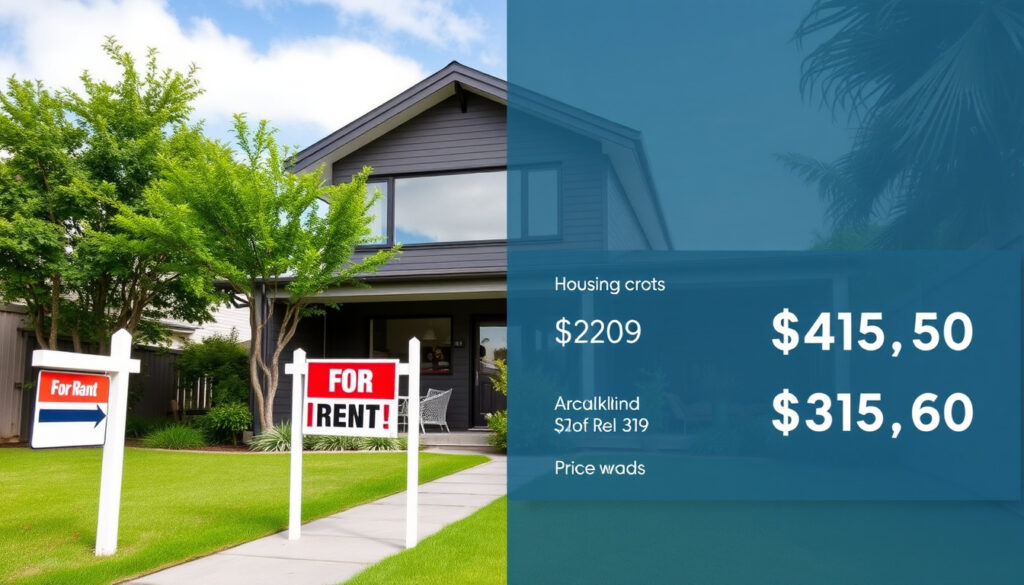
House in Auckland for Rent: 2025 Costs & Comparisons
Anyone who’s tried searching for a house in Auckland for rent in 2025 knows the drill: listings vanish within days, and the city’s rental price index hit $675 in July 2025. This data-driven guide breaks down what you’ll pay across suburbs, income needed, and how Auckland compares globally.
Rental listings on Trade Me: 5,724+ ·
Cheapest weekly rent: Under $500 ·
Most searched property type: 3-bedroom house
Quick snapshot
- Average weekly rent across Auckland reached $675 in July 2025 (Trade Me Property (NZ’s largest listing platform)).
- Auckland is the most expensive rental market in New Zealand (Trade Me Property).
- Entry-level houses in South Auckland rent for under $500 per week (Barfoot & Thompson).
- Exact average rent for a 3-bedroom house depends on precise location and current market.
- Future rent price trends after 2025 are uncertain.
- The true cost of living comparison across countries varies by lifestyle.
- Trade Me’s rental index climbed from $660 (early 2025) to $675 (July 2025) (Trade Me Property).
- Barfoot & Thompson data shows a 2-3% quarterly increase for 3-bedroom houses. (Trade Me Property)
- Rents are projected to stabilize as building consents remain high.
- Interest rates and migration flows will be key drivers of any price changes.
- More supply in South Auckland may ease pressure on the lowest-priced segments.
The latest snapshot from the city’s rental data reveals stark variation across bedrooms and suburbs.
| Metric | Value |
|---|---|
| Rental listings on Trade Me | 5,724+ |
| Cheapest weekly rent | Under $500 |
| Popular search phrase | Cheap houses for rent in Auckland under $500 |
| Most searched rental type | 3-bedroom house |
| Auckland Avg Rent (3-bed, Barfoot) | $693/week |
| Auckland Avg Rent (2-bed, Barfoot) | $580/week |
| South Auckland Avg Rent (1-bed) | $389/week |
| West Auckland Avg Rent (3-bed) | $645/week |
Data sourced from Barfoot & Thompson (Auckland’s biggest real estate agency) and Trade Me Property (NZ’s largest listing platform).
How expensive is rent in Auckland?
How much is an average house in Auckland?
- The average weekly rent across all Auckland properties sits at $675 (Trade Me Property, July 2025).
- A typical 3-bedroom house rents for $750 per week, rising to $800 with a second bathroom.
- Barfoot & Thompson’s managed portfolio averages $693 for a 3-bedroom home (Barfoot & Thompson, April 2025).
Trade Me’s broader dataset captures a wider range of listings—from high-end waterfront houses to modest suburban homes. The $675 median means half of all properties cost less, half cost more. For renters targeting a standard 3-bedroom dwelling, budgeting between $600 and $800 weekly covers the vast majority of options.
A $50 difference per week equals $2,600 over a year—enough to cover annual electricity bills for most Auckland households. Suburb selection is the single most powerful lever renters have.
The choice of suburb can save or cost thousands annually.
Is Auckland a cheap place to live?
- Auckland is consistently ranked as New Zealand’s most expensive city for renters.
- Rents in the City of Sails are roughly 20-30% higher than in Christchurch or Dunedin.
- Globally, Auckland sits in the middle range—far cheaper than Sydney, London, or San Francisco.
The Numbeo (crowdsourced global cost database) gives Auckland a rent index of 45.9, compared to 81.3 for London and 100 for New York. While Auckland is not cheap by local standards, it offers meaningful savings versus peer cities in North America and Europe.
What factors influence rent prices in Auckland?
- Location: Suburbs closer to the CBD and waterfront command a strong premium.
- Property size: 3-bedroom houses are the most searched type, keeping prices firm.
- Age and condition: New builds attract higher rents; older homes may be cheaper.
- School zones: Suburbs with high-decile schools see rent premiums of 10-15%.
Why this matters: Location accounts for a $200-$400 per week gap between central suburbs and South Auckland. A 30-minute commute can save a family over $15,000 per year in rent.
How much do you need to earn to live comfortably in Auckland in 2025?
What is a good salary to live in Auckland?
- Budgeting experts advise keeping housing costs at 30-40% of gross income.
- A 3-bedroom house at $750/week requires a household income of roughly $80,000-$100,000.
- A 1-bedroom apartment at $454/week is manageable on a salary of $50,000-$65,000.
According to Interest.co.nz (NZ finance analysis site), the median New Zealand household income was around $85,000 in 2024, putting the typical family right at the affordability threshold for a standard Auckland rental. Single earners face a tighter squeeze, with an average 1-bedroom rent consuming 35-40% of a median single income.
What is the cost of living for a single person in Auckland?
- Monthly costs for a single person (rent + utilities + food + transport) range from $2,400 to $2,800.
- Average 1-bedroom rent is $454 per week, per Barfoot & Thompson.
- Weekly grocery bill for one person averages $80-$120 in Auckland supermarkets.
Single renters face proportionally higher housing costs. A 1-bedroom unit eats roughly 35% of a $55,000 salary, leaving thin margins for savings or leisure. Flatting (sharing a 3-bedroom house) can slash weekly rent to $250-$300.
The takeaway: income and housing costs are tightly linked, and choosing a cheaper suburb can free up significant budget.
How does the cost of living in Auckland compare to other New Zealand cities?
- Auckland is about 18% more expensive than Wellington for renters.
- Christchurch rents average $100-$150 less per week than Auckland.
- Dunedin is among the cheapest major centers, with 3-bedroom rents averaging $450-$550.
The pattern is consistent: moving two hours south to the Waikato region drops rent by hundreds of dollars per week, making it a viable alternative for remote workers. For more on the cheapest suburbs, check out our affordable areas analysis.
Where is the cheapest rent in New Zealand?
What is the most affordable place to live in Auckland?
- South Auckland (Papakura, Manurewa, Ōtara) offers the lowest median rents. Barfoot & Thompson’s average for a 1-bedroom is $389.
- West Auckland (Glendene, Glen Eden, Massey) averages $645 for a 3-bedroom.
- Franklin/Manukau Rural shows 2-bedroom averages at $500 per week.
Data from Barfoot & Thompson (Auckland’s biggest real estate agency) confirms that these areas consistently rent 20-30% below the city median. Separate data from Crockers (NZ property management firm) puts West Auckland averages at $768 for April 2025, confirming a significant price gap between central and outer suburbs.
Lower rent in South or West Auckland often comes with longer commutes or fewer amenities. A $100 weekly saving can be offset by $40 in extra transport costs and 40 minutes of daily travel time.
The catch: lower rent often comes with trade-offs in commute and amenities.
Where are the cheapest houses in NZ?
- Invercargill and Dunedin lead as the cheapest cities for rentals, with 3-bedroom houses from $350-$450 per week.
- Gisborne and Whanganui also offer well-below-national-average rents.
- Trade Me data suggests the national median rent is $600, meaning most towns outside main centers are cheaper.
Renters willing to relocate beyond Auckland save significantly. A remote worker earning an Auckland salary while living in Invercargill could pocket $15,000-$20,000 per year in rent alone.
What suburbs in Auckland offer the best value rentals?
- Papakura: consistently 10-20% below city median rent.
- Papatoetoe: strong transport links and affordable housing stock.
- Glen Eden: West Auckland’s best balance of price and commute.
These suburbs deliver decent transport links while keeping rent well below the Auckland average. According to Realestate.co.nz (national property platform), listing volumes in these suburbs have increased in 2025, giving renters more choice than in tighter central markets.
Is it cheaper to live in NZ or USA?
Is it cheaper to live in NZ or UK?
- Consumer prices in Auckland are 5-10% lower than in London.
- Rent in Auckland is about 30% cheaper than in the UK capital.
- Groceries and utilities are slightly higher in NZ, but this is offset by lower housing costs.
Comparisons from Numbeo (crowdsourced global cost database) show a family of four in Auckland spends roughly $3,800 USD per month on living costs, versus $4,900 USD in London.
How do rents in Auckland compare to New York or London?
- New York median rents are 2-3 times higher than Auckland’s.
- Manhattan average rent for a 1-bedroom apartment exceeds $3,500 USD per month.
- San Francisco rents are roughly 4x Auckland’s equivalent.
For a US-based remote worker earning $80,000 USD, moving to Auckland cuts housing costs by over $2,000 USD per month—potentially funding an entire year of international travel or a significant savings boost.
The bottom line: New Zealand offers significant housing savings compared to major global cities, especially for families.
What are the main factors that make NZ cheaper overall?
- No tipping culture and lower sales tax (GST is 15% vs variable US state taxes up to 10%+).
- Subsidized public healthcare reduces or eliminates private insurance premiums.
- University education is far cheaper than US rates, with domestic tuition subsidized by the government.
The implication: While Auckland groceries and petrol cost more than in the US, the total cost of living for a family with children is substantially lower due to healthcare and education savings. Read our minimum rent guide for more on the bottom end of the market.
Three cities, one metric: weekly rent for a standard 3-bedroom house in a median suburb.
| City | Avg 3-bed weekly rent | Annual cost (52 weeks) |
|---|---|---|
| Auckland | $750 | $39,000 |
| New York (Manhattan) | $3,500 USD | $182,000 USD |
| London | £550 | £28,600 |
| Sydney | $1,000 AUD | $52,000 AUD |
Sources: Trade Me Property, Numbeo, and local rental databases for each market.
How can I find a house for rent in Auckland?
What documents do I need to rent a house in Auckland?
- Proof of income (pay slips or employment contract).
- Photo identification (passport or NZ driver’s license).
- Rental references from your current or previous landlord.
- Bank statements (sometimes required to show savings or rent history).
Tenancy Services, the New Zealand government’s regulatory body, recommends having these documents ready before you start viewing properties (Tenancy Services (government regulatory body)). This preparation can mean the difference between securing a lease and missing out.
What should I look for in a rental property?
- Check for the mandatory insulation certificate and Healthy Homes compliance statement.
- Test the heating, water pressure, and internet connectivity during the viewing.
- Look for signs of dampness or mold, especially in older villas and unit blocks.
- Note the condition of locks, windows, and security features.
New Zealand rental laws require landlords to provide a dry, warm home. Properties that meet these standards tend to cost more upfront but save on power bills and health issues later.
How to apply and secure a rental property?
- Submit your application immediately—properties often rent within 48 hours of listing.
- Offer the asking price or slightly above in competitive situations.
- Follow up with the property manager within 24 hours to confirm receipt.
Scams targeting renters exist. Never transfer money for a bond or rent without viewing the property in person. Legitimate agencies never ask for payment before a signed tenancy agreement.
The key: preparation and speed are essential in a competitive market.
What is the minimum house rent in Auckland?
Can I find a house for rent under $500 per week?
- Yes, but options are limited to small units, studios, or shared accommodations in outer suburbs.
- Barfoot & Thompson’s South Auckland 1-bedroom average of $389/week falls under $500.
- Complete houses at this price usually require compromises on size or location.
The verdict: budget-conscious renters should look to South and West Auckland or consider flatting.
What are the smallest or cheapest rentals available?
- Studio apartments in the Auckland CBD occasionally dip under $350/week.
- Bedsits and boarding rooms in inner suburbs can rent for $250-$300/week.
- Flatting (sharing a 3-bedroom house) divides the $750 weekly rent, often costing each flatmate $250-$300.
These options trade square footage and privacy for affordability. They are high-turnover listings suited for singles or students. Check Trade Me filters for “Studios” under “$350.”
Are there any subsidized housing options?
- Kāinga Ora (Homes and Communities) provides state housing for eligible low-income families.
- The Income-Related Rent Subsidy can cap rent at 25% of income.
- Waiting lists often exceed 12 months for high-demand areas.
For more details, visit Kāinga Ora – Homes and Communities (government housing agency). Check our rental process section for practical application tips.
Confirmed facts vs. what’s unclear
Confirmed facts
- Rent prices in Auckland vary widely by suburb (Trade Me Property).
- Trade Me lists over 5,700 rental properties in Auckland (Trade Me Property).
- The minimum rent for a house can be under $500 per week (Barfoot & Thompson).
- A comfortable salary is $80,000-$100,000 for a family (Interest.co.nz).
- Auckland is cheaper than New York, London, and Sydney for renters (Numbeo).
What’s unclear
- Exact average rent for a 3-bedroom house depends on precise location and current market.
- Future rent price trends after 2025 are uncertain.
- The true cost of living index comparison across countries can vary based on lifestyle.
- How quickly the rental market will absorb new supply in South Auckland.
- The precise impact of interest rate changes on rent prices in 2025 remains uncertain.
What renters and experts say
“The market is incredibly competitive right now. We’re seeing multiple applications for every listing within the first 48 hours. Tenants who have their references and pre-approval ready are the ones who land the property.”
— Property Manager, Auckland Real Estate Agency
“I moved from Wellington thinking Auckland wouldn’t be that different, but my rent jumped $150 a week for a similar apartment. I had to adjust my budget quite a bit, but the job opportunities made it worth it.”
— Recent Auckland Arrival
“My advice to anyone moving to Auckland is to keep your housing costs under 35% of your gross income. If that means choosing a cheaper suburb and commuting, it’s a smarter long-term move than being rent-stressed in the CBD.”
— Financial Advisor, Relocation Specialist
The Auckland rental market in 2025 is a study in contrasts: world-class city amenities paired with a cost structure that increasingly squeezes middle-income earners. South and West Auckland remain viable entry points, but the gap is narrowing. For a family earning $85,000, the decision to rent in Auckland versus a Waikato satellite town or a Christchurch suburb is a direct trade-off between career access and financial breathing room. The implication is clear: prioritize your housing budget ruthlessly, or prepare to leave the city.
Related reading: Auckland house rentals in 2025: cheapest suburbs, cost-of-living, and sub-$500 weekly options · Auckland house rentals in 2025: cheapest suburbs, cost-of-living, and sub-$500 weekly options
trademe.co.nz, trademe.co.nz, trademe.co.nz, trademe.co.nz, trademe.co.nz, trademe.co.nz, trademe.co.nz, realestate.co.nz, trademe.co.nz, trademe.co.nz
Frequently asked questions
What is the typical process for applying for a rental in Auckland?
Most landlords use a standard application form. You’ll need proof of income, ID, and previous rental references. Many agencies now require pre-approval before you can view a property.
How do I compare rental listings effectively?
Focus on total weekly cost, bond required, and whether utilities are included. Check for insulation certificates and healthy homes compliance. Location vs commute time is the biggest decision factor.
What rights do tenants have regarding rent increases?
In New Zealand, rent can only be increased once every 12 months. The landlord must give 60 days’ written notice. You can challenge excessive increases at the Tenancy Tribunal.
Are there any upfront fees when renting a house in Auckland?
Yes. Bond is usually 4 weeks’ rent, and the first week’s rent is paid upfront. Letting fees for tenants were banned in 2018, so you should not be charged a fee by the property manager.
Can I negotiate the rent with a landlord?
Negotiation is possible, especially if the property has been listed for a while or has minor issues you can fix yourself. Offer a longer lease term in exchange for a lower weekly rate.
What utilities should I expect to pay separately?
Electricity, gas (if applicable), water (if metered), and internet are typically not included in the rent. Some apartments include water and a building maintenance fee.
What salary is needed to rent a house in Auckland in 2025?
For a median $675/week house, a household income of at least $80,000 per year is recommended to keep housing costs under 40% of gross income.
More related posts
 Open Bank Account Online NZ – Steps, Documents and Banks
 Service Station Near Me: Fuel, Parking & Services in Ireland
 Nothing Beats a Jet2 Holiday – ATOL Protection, Reviews and Awards
 ANZ NZ Internet Banking – goMoney Login, Features and Guide
 West Indies vs England: How to Watch, Records & 2026 Guide
 How to Identify Bird Species: Top Free Tools & Tips
 Famous People from New Zealand: Top Kiwi Icons & Celebrities
 What to Do in Paihia: Top Activities, Free Things & Guide