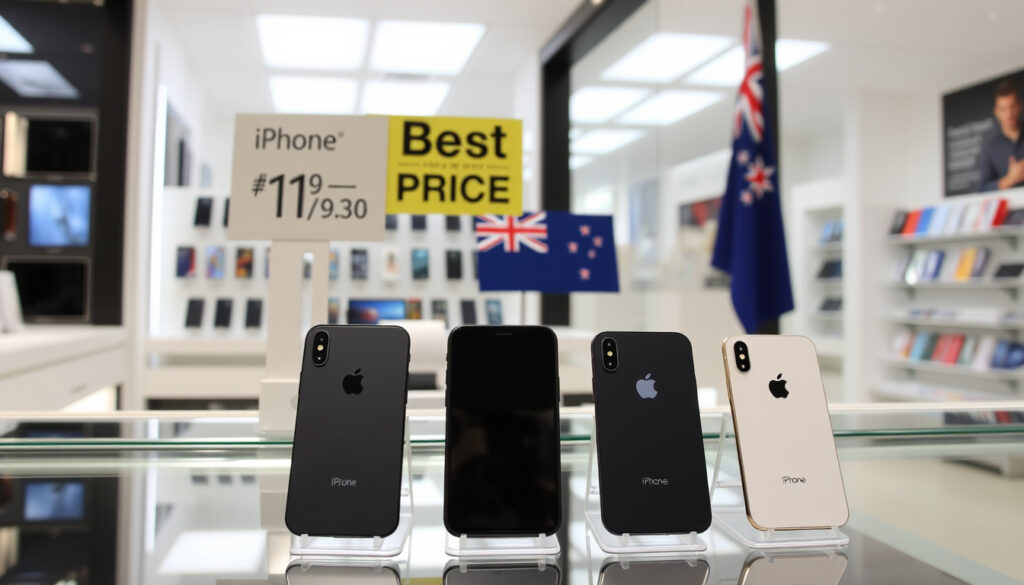
iPhones for Sale NZ: Best Prices & Buying Guide 2026
Few decisions in tech feel as personal as picking your next iPhone. Local retailers carry every option — new, refurbished, and unlocked — so you can see exactly what you’re paying for.
Current iPhone models available: 6 (iPhone 11, 13, 14, 15, 16, 17) ·
Price range (new, NZD): $1,299 – $2,349 ·
Average lifespan: 4–7 years ·
Cheapest new iPhone: iPhone 15 128GB at $1,299 (Noel Leeming) ·
Refurbished warranty: 1 year (Mobile City)
Quick snapshot
- iPhone 15 128GB price $1,299 at Noel Leeming (Noel Leeming (NZ retailer))
- Apple NZ official lineup: iPhone 16, 17e, 17, 17 Air, 17 Pro (Apple New Zealand (official manufacturer site)) (Noel Leeming (NZ retailer))
- One NZ offers iPhone 17 starting at $1,699 (One NZ (carrier partner)) (Noel Leeming (NZ retailer))
- Mobile City refurbished iPhones come with 1‑year warranty (Mobile City (refurbished specialist))
- Exact launch date of next iPhone model in New Zealand
- Trade‑in value fluctuations between carriers
- Future iOS support cutoff for iPhone 13
- iPhone 17e announced March 2026 (One NZ (carrier partner))
- Apple NZ iPhone page last updated 20 June 2026 (Apple New Zealand (official manufacturer site))
- New model release likely late 2026 or early 2027
- Trade‑in promotions may shift with carrier seasonality
- Battery replacement costs remain around $100–$150
Here are the key facts at a glance.
| Metric | Value |
|---|---|
| Cheapest new iPhone | iPhone 15 128GB – $1,299 (Noel Leeming) |
| Longest software support | iPhone 15, 16, 17 (released 2023‑2025) |
| Best value for money | iPhone 14 or 15 (depending on budget) |
| Refurbished leader | Mobile City – 1‑year warranty, new battery |
What’s the cheapest place to buy an iPhone?
New Zealand buyers have several avenues for snagging an iPhone at the lowest price, but the cheapest option depends on whether you want new, refurbished, or second‑hand.
Where to find second hand iPhones in NZ
The second‑hand market in New Zealand is active on Trade Me (NZ auction platform) and Facebook Marketplace (community marketplace). Prices can be significantly lower — an iPhone 11 reportedly sells for around $400–$500 — but you get no warranty and the device’s battery history is unknown. Reddit discussions among Kiwis often highlight the importance of buying unlocked, contract‑free phones when comparing deals (Reddit r/newzealand (community discussion)).
What is the price of iPhone 17 in NZ?
The iPhone 17 starts at $1,699 from One NZ, and the iPhone 17e 512GB is listed from $1,597 on PriceSpy. These represent the latest generation available in New Zealand.
iPhone clearance deals in NZ
Clearance sales happen periodically at Noel Leeming (major electronics retailer) and PBTech (online tech retailer) when new models drop. For example, the iPhone 15 128GB has been seen at $1,299 — the lowest new‑iPhone price currently available in NZ. Noel Leeming’s Price Promise also means you can get a partial refund if you find a lower price elsewhere within 30 days.
How to buy an unlocked iPhone in NZ?
For a true unlocked (SIM‑free) iPhone, Apple New Zealand (official manufacturer store) offers all models without carrier locks. JB Hi‑Fi NZ (electronics retailer) also sells unlocked models and provides a useful iPhone comparison page with 5G carrier compatibility notes. Buying unlocked gives you the freedom to switch between Spark, One NZ, or 2degrees without any restrictions.
You can save up to $200 by buying unlocked from Apple NZ rather than a carrier bundle, but you lose the ability to spread payments over 24–36 months with zero interest — a real consideration for budget‑conscious buyers.
The implication: if you can pay upfront, an unlocked iPhone from Apple NZ or JB Hi‑Fi typically gives you the lowest total cost of ownership. If you need monthly payments, carrier deals from One NZ or Spark become more attractive, even though the upfront price is higher.
Are refurbished iPhones reliable?
Refurbished iPhones from specialists like Mobile City are tested, include a new battery, and come with a 1‑year warranty. This makes them a reliable mid‑ground between new and second‑hand, especially for models like the iPhone 14 or 15.
Which iPhone is better, 13 or 14 or 15?
Choosing between these three models is the most common dilemma for NZ shoppers because they span a critical price band. Here’s how they stack up on specs and real‑world value.
iPhone 13 vs 14 vs 15: key differences
The specs reveal a clear generational leap.
| Feature | iPhone 13 | iPhone 14 | iPhone 15 |
|---|---|---|---|
| Chip | A15 Bionic | A15 Bionic (extra GPU core) | A16 Bionic |
| Display | 6.1” 60Hz OLED | 6.1” 60Hz OLED | 6.1” 60Hz OLED |
| Camera | Dual 12MP | Dual 12MP | Dual 48MP (main) |
| Port | Lightning | Lightning | USB‑C |
| Dynamic Island | No | No | Yes |
| Crash Detection | No | Yes | Yes |
| Price (new, NZD) | ~$1,099 (if available) | ~$1,199 (if available) | $1,299 (Noel Leeming) |
Three models, one pattern: each generation adds a marquee feature — USB‑C and the 48MP camera on the 15 are the biggest leaps. The 14 adds crash detection but keeps Lightning; the 13 still runs on the A15 chip, which remains capable for everyday tasks.
Which model offers the best value in NZ?
For most New Zealand buyers, the iPhone 15 hits the sweet spot. You get USB‑C (future‑proofed for NZ’s charging ecosystem), a significantly better camera, and Dynamic Island for around $1,299. The iPhone 14 is a solid mid‑range option if you don’t mind Lightning, but its price premium over a used 13 is often too small to justify — you might as well stretch to the 15.
Which iPhone has the least problems?
Apple New Zealand (official manufacturer site) doesn’t publish reliability statistics, but community reports suggest later models — especially the 15 and 16 series — have fewer hardware issues out of the box. The iPhone 13 launched during the chip shortage era, and some units experienced battery calibration oddities. That said, a refurbished unit from Mobile City (refurbished specialist) with a new battery largely sidesteps those risks.
Which iPhone should I buy in NZ?
With the lineup running from the budget iPhone 11 (refurbished) to the flagship iPhone 17 Pro, the best choice depends on your budget and how long you intend to keep the phone.
What is the cheapest but best iPhone to buy?
The iPhone 15 is the consensus pick for the cheapest iPhone that doesn’t feel compromised. It starts at $1,299 new from Noel Leeming, and Apple New Zealand (official manufacturer store) sells it with the option of trade‑in. If $1,299 is still too steep, a refurbished iPhone 14 from Mobile City (with 1‑year warranty) comes in around $900–$1,000.
Is it worth buying an iPhone 14 or 15?
Yes, for different reasons. The iPhone 14 is worth it if you find a deal under $1,100 — it still has crash detection and a dual‑camera system that takes great photos. The iPhone 15 is worth the extra $200 because USB‑C makes charging simpler (especially if you also own a MacBook or iPad) and the 48MP camera gives you more cropping flexibility. JB Hi‑Fi NZ (electronics retailer) lets you compare all models side by side, including carrier compatibility.
Which iPhone is worth buying now?
If you need a new phone today, the iPhone 17e (announced March 2026, starting around $1,597 from PriceSpy) is the newest budget‑oriented model. But for most Kiwis, the iPhone 15 at $1,299 offers the best balance of modern features and price — it will receive iOS updates through at least 2030, giving you a 5‑year practical lifespan.
Buying the cheapest model (iPhone 11 refurbished, ~$400) saves money now but may leave you without security updates by 2028. For a student or light user, that might be fine; for anyone using banking apps or storing personal data, a newer model is safer.
How long do iPhones typically last?
New Zealand consumer guarantees cover new iPhones for two years, but the hardware and software can last much longer if you look after the battery.
Software support lifespan of iPhone models
Apple Support NZ (official documentation) states that iPhones typically receive major iOS updates for 5–7 years after launch. For example, the iPhone 6s got iOS 15 in 2021 — six years after it launched. The iPhone 13, released in 2021, will likely be supported until at least 2026–2027. That means an iPhone 13 bought in 2026 (refurbished) may only get one or two more iOS versions.
Battery degradation and replacement
Battery health drops significantly after 2–3 years of daily use. Apple New Zealand (official support page) quotes battery replacement costs around $100–$150 NZD, depending on the model. After a replacement, the phone feels like new for another 2–3 years.
When should you replace your iPhone?
A good rule of thumb: replace when (a) your battery health drops below 80%, (b) the current iOS version no longer receives security patches, or (c) the phone struggles with everyday apps like Facebook or email. For most users, that happens after 4–6 years. The DODOcase guide on iPhone longevity puts typical usage at 4 to 7 years (DODOcase (accessory maker guide)).
The implication: buying a model that’s already two years old (like the iPhone 13 in 2026) cuts your usable life to 2–3 years unless you replace the battery. If you want maximum lifespan without a battery swap, buy the current generation.
Is the iPhone 13 too old in 2026?
That depends on your expectations. The iPhone 13 is still a powerful phone, but it’s entering the twilight of its software support lifecycle.
Performance and software support for iPhone 13 in 2026
The A15 chip in the iPhone 13 remains capable for browsing, social media, streaming, and light gaming. However, as of mid‑2026, the iPhone 13 originally shipped with iOS 15, and it is currently on iOS 18 or 19 (depending on eligibility). Apple typically drops support after 5–6 major versions, so the iPhone 13 may not get iOS 20. That means you could miss out on security patches by 2027 or 2028. Apple New Zealand (official comparison page) lists only models from iPhone 15 and newer as “designed for Apple Intelligence,” indicating the 13 is now considered legacy.
Should you buy a new iPhone 13 or refurbished?
Buying a new iPhone 13 in 2026 makes little sense — you’d pay near RRP for a phone with limited remaining support. A refurbished iPhone 13 from Mobile City (refurbished specialist) costs around $600–$800 and is a good option for a child or as a backup device. For a daily driver, spend the extra on an iPhone 15 or 17e.
The trade-off: a refurbished iPhone 13 can still do everything a casual user needs, but you’ll be forced to upgrade again in 2 years. The total cost of ownership over 4 years may be higher than buying a new iPhone 15 outright.
Four iPhones, one pattern: the newer the model, the longer it stays relevant, but the higher the upfront cost.
| Model | Release year | iOS support ends (approx.) | Best for |
|---|---|---|---|
| iPhone 13 | 2021 | 2027 | Budget users, kids, backup phones |
| iPhone 14 | 2022 | 2028 | Mid‑range buyers who want crash detection |
| iPhone 15 | 2023 | 2029 | Best all‑round value in NZ |
| iPhone 17e | 2026 | 2032 | Future‑proofed budget pick |
Six spec categories, one takeaway: the iPhone 15 and later models bring USB‑C and the 48MP camera, which are tangible daily upgrades over the Lightning‑era phones.
| Specification | iPhone 13 | iPhone 14 | iPhone 15 | iPhone 17e |
|---|---|---|---|---|
| Chip | A15 | A15 (5‑core GPU) | A16 | A18 or later |
| RAM | 4GB | 6GB | 6GB | 8GB (est.) |
| Storage options | 128/256/512GB | 128/256/512GB | 128/256/512GB | 128/256/512GB |
| Main camera | 12MP f/1.6 | 12MP f/1.5 | 48MP f/1.6 | 48MP f/1.6 (est.) |
| Ultra‑wide | 12MP | 12MP | 12MP | 12MP |
| Port | Lightning | Lightning | USB‑C | USB‑C |
| Dynamic Island | No | No | Yes | Yes |
| Crash Detection | No | Yes | Yes | Yes |
| 5G | Yes | Yes | Yes | Yes |
| Battery (mAh) | 3,095 | 3,279 | 3,349 | ~3,500 (est.) |
Upsides
- USB‑C on iPhone 15 and later simplifies charging
- Refurbished options from Mobile City save 30–40%
- NZ consumer guarantee covers new iPhones for 2 years
- iOS updates for 5–7 years per model
Downsides
- New models are expensive ($1,299–$2,349)
- Battery replacement needed after 2–3 years
- Older models (iPhone 13) nearing software end‑of‑life
- Trade‑in values vary wildly between carriers
How to buy an iPhone in NZ: step‑by‑step
- Set your budget. Decide how much you want to spend. New iPhones start at $1,299 (iPhone 15); refurbished models start around $400.
- Choose your source. New: Apple NZ, Noel Leeming, PBTech, One NZ, Spark. Refurbished: Mobile City (1‑year warranty). Second‑hand: Trade Me, Facebook Marketplace.
- Check your network. All current iPhones support 5G on Spark, One NZ, and 2degrees. If you’re on a prepaid plan, an unlocked phone is essential.
- Compare prices. Use PriceSpy NZ (price comparison tool) to see the lowest current price across retailers. Noel Leeming’s Price Promise can match or beat competitors.
- Consider trade‑in. Apple NZ, One NZ, and Spark all offer trade‑in credits. A used iPhone 12 can knock $200–$400 off the new price.
- Buy and activate. If buying from a carrier, you may need to sign a 24‑month plan. If buying unlocked, simply insert your SIM and go.
- Protect your investment. Buy a case and screen protector. Consider AppleCare+ for accidental damage coverage.
A shopper who follows these steps can save between $150 and $500 compared to walking into the first store they see — and end up with a phone that fits their actual usage patterns, not just the latest marketing push.
What we know for sure
- iPhone 15 128GB costs $1,299 at Noel Leeming (Noel Leeming (NZ retailer))
- Apple NZ sells unlocked iPhones with full NZ warranty (Apple New Zealand (official manufacturer store))
- Refurbished iPhones from Mobile City include a new battery and 1‑year warranty (Mobile City (refurbished specialist))
- iPhone 17e was announced in March 2026 (One NZ (carrier partner))
What’s still uncertain
- Exact trade‑in values next quarter – subject to carrier promotions
- Future iOS support cutoff for iPhone 13 – not confirmed by Apple
- PriceSpy listings may lag behind actual retail prices (PriceSpy NZ (price comparison tool))
Apple is the best place to buy iPhone. Shop iPhone Financing.
Apple New Zealand (official manufacturer store)
Tested, new battery, 1‑year warranty. Easy payments like Afterpay & ZIP.
Mobile City (refurbished specialist)
For New Zealanders shopping for an iPhone in 2026, the smartest move is to target an iPhone 15 (new) or a refurbished iPhone 14 from a warranty‑backed seller like Mobile City. The iPhone 13 is only a short‑term option unless you’re willing to replace the battery soon. For the majority of Kiwi buyers, the choice is clear: spend $1,299 on a new iPhone 15 and you’ll get a phone that stays fast, secure, and supported through 2029 — anything cheaper now will cost you more in upgrades later.
Frequently asked questions
Is it safe to buy second‑hand iPhones in NZ?
It can be safe if you buy from a reputable refurbisher like Mobile City (1‑year warranty) or through Trade Me’s buyer protection. Avoid cash‑and‑carry deals from unknown sellers without proof of original purchase.
Do NZ retailers offer trade‑in deals for iPhones?
Yes. Apple NZ, One NZ, and Spark all accept trade‑ins. An iPhone 12 in good condition can fetch between $200 and $400 off a new model, varying by carrier and promotion timing.
What network compatibility do iPhones have in New Zealand?
All current iPhones sold in NZ support 5G on Spark, One NZ, and 2degrees. Older models (iPhone 11 and earlier) are 4G only. JB Hi‑Fi NZ provides a carrier compatibility chart.
Should I buy a SIM‑free or carrier‑locked iPhone in NZ?
SIM‑free (unlocked) is best for flexibility — you can switch carriers anytime. Carrier‑locked phones from One NZ or Spark are locked for 24 months but often come with discounted plans.
What is the return policy for iPhones at Noel Leeming?
Noel Leeming offers a 30‑day change‑of‑mind return on most products, including iPhones, as long as they are unopened. Opened phones may incur a restocking fee. Always check the specific policy at purchase.
Can I use Afterpay to buy an iPhone from Mobile City?
Yes, Mobile City accepts Afterpay and ZIP for refurbished iPhones, making it easier to spread the cost over several weeks without interest.
Are there student discounts on iPhones in NZ?
Apple NZ offers education pricing for students and teachers, typically a 5–10% discount on Macs and iPads. Discounts on iPhones are rare — check the Apple Education store directly.
More related posts
 Sarah J Maas Books in Order: Complete 2024 Reading Guide
 Kiwibank Lowers Home Loan Rates: 3-Year Fixed 5.35%
 Westpac Home Loan Rates – Current NZ Specials and Comparisons
 How to Get Rid of Mouth Ulcers Fast: Causes & Treatments
 Culture Kings Sylvia Park: Address, Hours, Reviews & More
 Joseph Gordon-Levitt: Career, Life & HitRecord Update
 Sydney Sixers vs Sydney Thunder Match Scorecard & Payments
 Nearby Pharmacies Open Now: Find Late-Night Chemists in Dublin