The Fellowship of the Ring – Plot, Characters and Full Guide
The Fellowship of the Ring is the opening volume of J.R.R. Tolkien’s monumental fantasy trilogy, The Lord of the Rings. Published in 1954 by George Allen & Unwin in the United Kingdom, it introduces readers to the quest to destroy the One Ring and establishes the world of Middle-earth that has captivated audiences for decades.
The novel begins in the peaceful Shire, where the hobbit Frodo Baggins inherits a mysterious ring from his uncle Bilbo. What follows is a journey across treacherous lands, filled with ancient evils, moral dilemmas, and an unlikely band of heroes drawn together by fate. As the first of three volumes, The Fellowship of the Ring sets the foundation for an epic struggle between the forces of darkness and the free peoples of Middle-earth.
This guide provides a comprehensive overview of the novel, from its publication history to its memorable characters and the critical differences between Tolkien’s original vision and later adaptations. The information presented draws from established sources including literary analyses and historical records.
What is The Fellowship of the Ring?
The Fellowship of the Ring serves as the first installment in Tolkien’s sweeping fantasy epic, running approximately 423 pages in its original UK hardcover edition. Published on July 29, 1954, the novel was followed by The Two Towers and The Return of the King, though all three were conceived as a single work. The book establishes the central conflict of the One Ring, the villainous Sauron, and the fellowship of nine walkers tasked with preventing catastrophe.
J.R.R. Tolkien
1954
Fantasy Epic
The Lord of the Rings #1
The novel weaves together multiple storylines, including Bilbo’s memoirs, the history of the One Ring, and the rising shadow of Sauron. Tolkien’s meticulous world-building creates a rich tapestry of languages, cultures, and histories that distinguish the work from conventional fantasy literature.
- Introduces the One Ring and the existential threat it poses to Middle-earth
- Forms the Fellowship of nine walkers united against Sauron’s forces
- Establishes the geography, cultures, and mythology of Middle-earth
- Explores themes of friendship, loyalty, and the corrupting nature of power
- Sets the narrative structure for the remaining two volumes
- Influenced the development of the modern fantasy genre significantly
- Demonstrates Tolkien’s expertise in linguistics, mythology, and medieval literature
| Fact | Detail |
|---|---|
| Original Title | The Fellowship of the Ring |
| Publisher (UK) | George Allen & Unwin |
| Page Count | Approximately 423 (first edition hardcover) |
| Followed By | The Two Towers |
| US Publisher | Houghton Mifflin |
| Publication Date | July 29, 1954 |
What is the plot of The Fellowship of the Ring?
The narrative unfolds in the Shire, a bucolic homeland inhabited by hobbits, where Bilbo Baggins celebrates his 111th birthday. During the festivities, Bilbo departs from the Shire abruptly, leaving behind his magic ring. The wizard Gandalf the Grey urges Bilbo to leave the ring with his nephew Frodo, warning that the artifact holds dark properties.
Gandalf investigates the ring’s origins and confirms its true nature: it is the One Ring forged by the Dark Lord Sauron, a weapon capable of dominating all other rings of power. Sauron, rebuilding his strength in the fortress of Mordor, seeks to recover the ring and extend his dominion over Middle-earth. The only path to victory lies in destroying the ring in the fires of Mount Doom within Mordor.
The Journey Begins
Frodo leaves the Shire accompanied by his loyal gardener Samwise Gamgee, joined en route by his cousins Meriadoc Brandybuck (Merry) and Peregrin Took (Pippin). The four hobbits encounter the Black Riders, servants of Sauron also known as the Nazgûl, who pursue them across the countryside.
Rescued first by the enigmatic Tom Bombadil in the Old Forest and subsequently by the ranger Aragorn in the village of Bree, the hobbits reach Rivendell, the dwelling of the elven lord Elrond. There, representatives of all free peoples convene at the Council of Elrond to determine the ring’s fate.
The Breaking of the Fellowship
At Elrond’s Council, Frodo volunteers as ring-bearer, accepting the burden of carrying the One Ring to its destruction. Elrond forms the Fellowship of nine walkers to escort Frodo, deliberately counterbalancing Sauron’s nine Nazgûl. The company includes Frodo, Sam, Merry, Pippin, Gandalf, Aragorn, Boromir of Gondor, Gimli the dwarf, and Legolas the elf.
The narrative employs multiple viewpoints, including Bilbo’s memoir recounting his earlier adventures, and interludes that detail the ring’s history. The Council of Elrond alone spans approximately 15,000 words, providing extensive background that Peter Jackson’s film adaptation condensed significantly.
The Fellowship attempts to cross the mountain Caradhras but turns instead to the dwarven kingdom of Moria, where they seek passage. Within Moria’s depths, Gandalf confronts a Balrog of Morgoth and falls into an abyss, leaving the company bereft of their wisest member.
The survivors reach Lothlórien, the realm of the Lady Galadriel, who provides aid and supplies. Traveling by boat down the Anduin River, the Fellowship experiences a period of peace before tensions erupt. Boromir, driven mad by the ring’s influence, attempts to seize it from Frodo at Amon Hen.
Frightened and guilt-ridden, Frodo resolves to continue alone to Mordor, slipping away under cover. Sam, discovering his master’s departure, insists on accompanying him. Meanwhile, Boromir falls defending Merry and Pippin from orcs and diesrepenting his moment of weakness.
Aragorn, Legolas, and Gimli pursue the orcs who have kidnapped Merry and Pippin, while Frodo and Sam venture eastward toward the Gates of Mordor, carrying the ring into the heart of enemy territory. The book concludes with the Fellowship shattered but the quest still alive.
Who are the members of the Fellowship of the Ring?
Elrond assembled the Fellowship specifically to counter Sauron’s nine Nazgûl, choosing representatives from each of the free peoples. The nine walkers embody the diversity of opposition to dark forces, combining mortal and immortal beings, warriors and simple folk united by common purpose.
The Nine Walkers
The four hobbits form the heart of the Fellowship, representing the ordinary folk drawn into extraordinary circumstances. Frodo Baggins serves as the Ring-bearer, a role that gradually corrupts and burdens him as the story progresses. His gardener Samwise Gamgee provides steadfast loyalty and practical support throughout the journey, never wavering in his devotion.
Merry and Pippin, while younger and more impulsive than Frodo, prove their courage repeatedly. Their youthful spirits and capacity for mischief mask deep reservoirs of loyalty and, eventually, strategic importance to the war effort against Sauron.
Gandalf the Grey serves as the Fellowship’s guide and moral center until his fall in Moria. The wizard’s wisdom and experience prove invaluable, and his loss creates a void the remaining members must fill through cooperation and newfound resolve.
Aragorn, known as Strider in Bree, carries the hidden identity of Isildur’s heir, the rightful king of Gondor and Arnor. His skills as a ranger and warrior make him essential to the company’s survival, while his birthright provides hope for the realms of men.
Boromir of Gondor brings martial prowess and noble intentions but ultimately succumbs to the ring’s temptation, illustrating the artifact’s power to exploit even the most virtuous hearts. His redemptive death provides one of the book’s most poignant moments.
Gimli the dwarf and Legolas the elf demonstrate that ancient enmities between their peoples can be set aside for a greater cause. Their developing friendship across racial lines signals Tolkien’s vision of unity among diverse peoples facing common threats.
Supporting Characters
Several characters not of the Fellowship nonetheless play crucial roles in the narrative. Bilbo Baggins, Frodo’s elderly cousin, provides context for the ring’s history through his memoir and offers emotional weight to the story’s beginning. Elrond hosts the Council and provides strategic guidance, while Galadriel equips the company for the road ahead.
The Fellowship deliberately mirrors Sauron’s nine Nazgûl in number, representing the united response of free peoples against domination. The inclusion of hobbits—the smallest and least warlike of Middle-earth’s peoples—underscores Tolkien’s theme that even humble beings can change the course of history.
Tom Bombadil, encountered in the Old Forest, represents an ancient being of mysterious origin who exists outside the ring’s influence. The antagonistic Sauron, though rarely present directly, drives the entire narrative through his machinations and the threat of his returning power.
Is The Fellowship of the Ring a book or a movie?
The Fellowship of the Ring is fundamentally a novel written by J.R.R. Tolkien, originally published in 1954. The book exists independently of any adaptation and contains substantial material that film versions have omitted or altered. The title refers specifically to the first volume of Tolkien’s three-part novel, which he originally conceived and published as a single extended work.
Peter Jackson directed a film adaptation released in 2001, which brought Tolkien’s vision to new audiences worldwide. The movie proved commercially successful and won critical acclaim, particularly for its visual representation of Middle-earth. However, the adaptation takes significant liberties with source material, condensing complex storylines and adding elements absent from the novel.
Why is it called The Fellowship of the Ring?
The title references the organized company of nine that forms around the Ring-bearer Frodo. Elrond chooses nine members deliberately, matching the number of Sauron’s Nazgûl and representing every free people: hobbits, wizards, elves, dwarves, and men. The title captures both the ring’s central importance and the theme of cooperation among diverse peoples facing shared threats.
Tolkien originally titled the work “The Lord of the Rings” with “The Fellowship of the Ring” serving as the first part’s designation. The naming convention reflects the trilogy’s structure as published, though Tolkien insisted the three volumes formed a single continuous narrative rather than separate novels.
Peter Jackson’s film omits several book elements including Tom Bombadil, the Old Forest, Barrow-downs, and the extended Council of Elrond sequence. The movie adds characters like Lúrtz (an Uruk-hai leader absent from the novel) and expands Arwen’s role significantly beyond her book appearances.
Publication and Adaptation Timeline
The book underwent a lengthy development process, with Tolkien working on the narrative for years before finding a publisher willing to commit to such an ambitious project. The volumes eventually published represent the culmination of decades of world-building and linguistic development that began during Tolkien’s academic career. More details about Tolkien’s publications are available through the Tolkien Society, which maintains extensive records on his works.
- – The Fellowship of the Ring published in the United Kingdom by George Allen & Unwin
- – United States edition published by Houghton Mifflin
- – Peter Jackson’s film adaptation released in theaters worldwide
- – Extended edition DVD released with additional footage
The original publication faced challenges common to ambitious fantasy works, with publishers uncertain about commercial viability. The trilogy’s eventual success transformed the fantasy genre and established Tolkien as a foundational figure in the field.
Book vs. Movie: What Remains Certain?
Core facts about the novel and its publication remain firmly established within Tolkien canon. The author’s identity, publication date, publisher, and page count are documented through publisher records and literary scholarship. The plot summary, character roster, and narrative structure derive from Tolkien’s original manuscript and have been verified through multiple scholarly editions.
Established Information
- J.R.R. Tolkien authored the work in English
- Published July 29, 1954, by George Allen & Unwin
- First volume of The Lord of the Rings trilogy
- Nine members comprise the Fellowship
- Frodo carries the One Ring to Mordor
- Gandalf falls battling a Balrog in Moria
- The book ends with the Fellowship broken
Information That Varies
- Film adaptations include scenes absent from the novel
- Character dialogue and specific moments altered
- Arwen’s role significantly expanded in the film
- Movie introduces Lúrtz, a character unknown to the book
- Pacing and sequence of events modified
- Visual representations of locations and creatures subject to creative interpretation
- Tom Bombadil entirely absent from adaptations
Film adaptations, while inspired by Tolkien’s work, represent interpretive creations rather than strict visual records of the text. Peter Jackson’s vision necessarily balances fidelity to source material against cinematic storytelling requirements, audience expectations, and production constraints. Fans interested in comparing the two can explore comprehensive analyses of the adaptations available through dedicated Tolkien research resources.
The Historical and Cultural Context of The Fellowship of the Ring
Tolkien composed The Fellowship of the Ring during and after World War II, a period that profoundly influenced its thematic concerns. The narrative explores questions of power, corruption, industrial warfare, and the struggle between freedom and domination that resonated with post-war readers and continue to resonate today.
The novel established templates and conventions that subsequent fantasy literature has repeatedly employed: the reluctant hero, the corrupting artifact, the diverse fellowship, and the journey into enemy territory. Tolkien’s meticulous world-building, including invented languages and detailed histories, raised expectations for fantasy world construction.
The Fellowship of the Ring launched one of the most successful entertainment franchises in history, encompassing films, games, merchandise, and ongoing literary scholarship. Its cultural impact extends beyond entertainment, influencing how readers understand heroism, friendship, and moral complexity in fiction. Academic institutions continue to study the novel’s influence, with scholarly analyses examining its enduring relevance.
Sources and Key Quotations
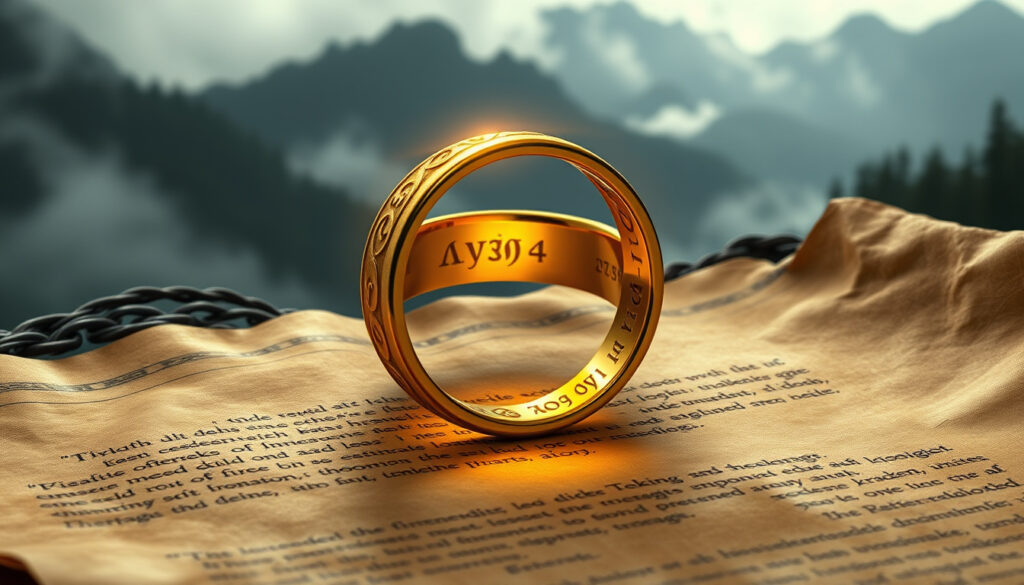
The novel opens with the famous inscription on the One Ring, a passage that establishes the stakes of the entire narrative. The verse has become synonymous with Tolkien’s vision of power and its dangers, appearing in adaptations, quotations, and scholarly analyses worldwide.
“One Ring to rule them all, One Ring to find them,
One Ring to bring them all and in the darkness bind them,
In the Land of Mordor where the Shadows lie.”— J.R.R. Tolkien, The Fellowship of the Ring
Information about publication history derives from publisher records maintained by the Tolkien Society and institutional archives. Plot summaries and character analyses draw from established literary resources including scholarly editions and authorized reference materials. The publisher archives provide primary documentation of the original publication details.
What Comes Next After The Fellowship of the Ring?
Readers who complete The Fellowship of the Ring typically continue with The Two Towers, which follows the scattered members of the Fellowship through separate storylines. The second volume develops the consequences of the Fellowship’s breaking and advances the war against Sauron.
Beyond the novels, audiences might explore Peter Jackson’s extended edition films, which restore approximately four hours of footage cut from theatrical releases. Audiobook adaptations offer another avenue for engaging with the material, with narrators like Rob Inglis bringing distinctive interpretations to Tolkien’s text.
For those interested in Tolkien’s broader mythology, The Silmarillion provides extensive background on Middle-earth’s creation and earlier ages. Fans of other anime series might also appreciate exploring Chainsaw Man Season 2 – Release Date, Trailer and Updates for comparable dark fantasy content, or Chainsaw Man Season 2 – Official Announcement and Key Details for recent announcements about upcoming seasons.
Frequently Asked Questions
How many pages is The Fellowship of the Ring?
The standard UK first edition hardcover spans approximately 423 pages. Page counts vary across editions, with some modern paperbacks exceeding 400 pages depending on formatting and font size.
What is the Fellowship in Lord of the Rings?
The Fellowship is a company of nine walkers formed by Elrond at Rivendell to escort Frodo Baggins and the One Ring to Mount Doom. It includes representatives from hobbits, wizards, elves, dwarves, and men.
Why is it called The Fellowship of the Ring?
The title references the nine-member company that forms around the Ring-bearer. “Fellowship” denotes the bond of loyalty among diverse characters united against Sauron, while “Ring” identifies the One Ring as the central object of the quest.
Who wrote The Fellowship of the Ring?
J.R.R. Tolkien, an Oxford professor of Anglo-Saxon literature, authored the novel. Tolkien developed the story as part of a larger mythology that included invented languages and extensive historical narratives.
What happens at the end of The Fellowship of the Ring?
The Fellowship breaks apart after Boromir’s attempted seizure of the Ring. Frodo and Sam depart secretly for Mordor, while Aragorn, Legolas, and Gimli pursue orcs holding Merry and Pippin captive.
Is The Fellowship of the Ring a book or a movie?
It is primarily a novel published by J.R.R. Tolkien in 1954. A film adaptation directed by Peter Jackson was released in 2001, but the book exists independently as the source material.
When was The Fellowship of the Ring published?
The novel was published on July 29, 1954, by George Allen & Unwin in the United Kingdom. The US edition followed shortly afterward through Houghton Mifflin.
More related posts
 Washing Machine Front Loader: Best Brands & Energy Tips
 Nintendo Switch 2 Games: List, Price, and Backward Compatibility
 Is Tova O’Brien Still Married? Partner, Kids & Career
 Jobs at New World: Application, Salaries & Reviews
 How to Identify Bird Species: Top Free Tools & Tips
 US Dollar to NZ Dollar: Current Rate & Travel Guide
 Animals Starting with U: Complete List with Facts & Pictures
 North Face Puffer Vest – Best Models and Sizing Guide