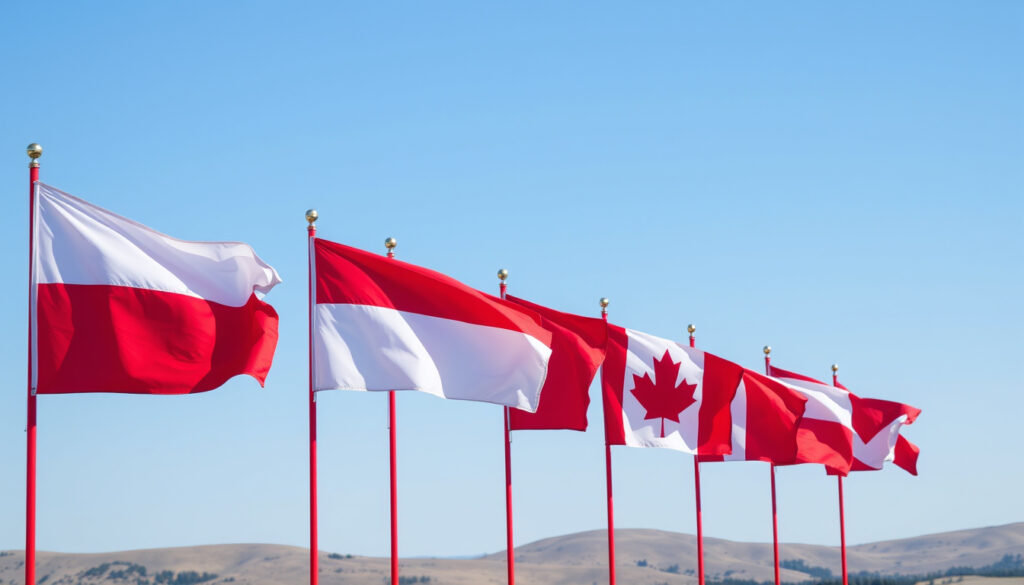
Red and White Flag: Countries, Meanings & Emoji IDs
The world’s most-searched flag colors aren’t blue or green—they’re red and white, a combination that trips up millions of searchers each year. Over a dozen sovereign nations use red and white, whether stacked horizontally, aligned vertically, or adorned with symbols, making quick identification genuinely difficult.
Countries with red and white flags: 12+ · Common design: Horizontal or vertical bicolor · Symbolic meaning: Red for sacrifice, white for purity · Examples: Poland, Indonesia, Malta · Nordic influence: Denmark’s cross design
Quick snapshot
- 12+ countries feature red and white flags (Owlcation flag analysis)
- Poland: white over red horizontal since 1410 (Owlcation flag analysis)
- Canada: red-white-red with maple leaf since 1965 (Owlcation flag analysis)
- Whether Irish flag confusion is tied to colonial history or design similarity
- Exact modern usage of the Refugee Nation flag outside activist circles
- Switzerland’s red-white-red triband: first used 1386 (EG Gradients flag history)
- Georgia’s current flag adopted 14 January 2004 (Britannica national flag reference)
- Vertical red-white flag designs growing in search interest
- Emoji identifiers increasingly used for quick flag recognition
Twelve nations share a palette of red and white, but their designs and meanings diverge sharply.
| Attribute | Details |
|---|---|
| Total countries | 12+ |
| Primary colors meaning | Red: blood/sacrifice, White: peace/purity |
| Common layouts | Horizontal bicolor, vertical, with emblems |
| Influential design | Denmark’s Dannebrog cross |
| Oldest red-white flag | Switzerland, 1386 |
| Newest adoption | Georgia, 14 January 2004 |
What flag is 🇵🇱?
Poland’s flag emoji 🇵🇱 appears in countless search queries, and for good reason. The design is straightforward: two horizontal bands, white on top and red below. But that simplicity hides centuries of history. White represents peace and purity, while red symbolizes the blood shed for independence — a meaning forged at the Battle of Grunwald in 1410, when Polish forces under King Władysław II Jagiełło defeated the Teutonic Knights.
Polish Flag Day significance
Poland celebrates Flag Day on May 2, coinciding with the anniversary of the adoption of the constitution. The flag doubles as a national emblem tied to the coat of arms of the Jagiełło dynasty, linking civilian and state uses directly to monarchical heraldry.
Horizontal white over red design
The horizontal white-over-red arrangement places Poland among the minority of nations that flip the more common red-over-white order. This distinction matters for quick identification: anyone seeing white on top is almost certainly looking at Poland, Monaco, or Bali.
Poland’s flag inversion means tourists frequently misidentify it on sight. Knowing the white-on-top rule prevents confusion with Indonesia or Austria, which use red-over-white or red-white-red arrangements.
What flag is 🇮🇩?
The Indonesia flag emoji 🇮🇩 ranks among the most-searched globally. Its design places red above white — the inverse of Poland’s arrangement. The colors carry precise meanings: red denotes bravery and the life of the people, while white represents purity and divine light. The combination traces back to the Majapahit empire (1293–1527), with the modern design in continuous use since 1870.
Meaning behind red and white
Indonesia’s founding philosophy, Pancasila, underpins the flag’s symbolism. Red stands for the Indonesian people and their courage, white for spiritual purity. This is not decorative metaphor but official national doctrine embedded in state ceremonies.
Horizontal bicolor layout
Like Poland’s design, Indonesia’s flag relies on two equal horizontal bands. The critical difference is color order. Red sits atop white in Jakarta, white atop red in Warsaw — a small detail that eliminates 90% of flag-confusion scenarios once remembered.
What flag is 🇲🇹?
Malta’s emoji 🇲🇹 masks a design unique among red-and-white flags: a vertical white band bearing a George Cross, flanked by two red bands. The cross itself was awarded by Britain’s King George VI in 1942 for Malta’s gallantry during World War II siege — not as a religious symbol but as military decoration.
George Cross detail
The George Cross dominates the white central band, making Malta’s flag instantly distinguishable from any other red-and-white design. This is not a Scandinavian cross (which includes arms extending to edges) but a centered medallion on a white field.
Vertical white and red
Malta is among the few nations using a vertical triband where white occupies the center. Combined with the cross emblem, this creates a flag that breaks both the horizontal-bicolor and plain-triband patterns common elsewhere.
Malta’s George Cross confuses visitors who assume it’s a religious symbol. In reality, the cross represents civilian gallantry — one of the highest British military honors — awarded during the island’s devastating WWII siege.
What flag is vertical red and white?
Searches for “vertical red and white flag country” reflect a common identification challenge. Several nations use vertical red-white-red or red-white-red tribands, but their meanings and origins differ sharply.
Middle East examples
Yemen’s flag features horizontal tricolor (red-white-black with a black chevron), but the vertical red-white-red arrangement identifies Peru and Canada. Peru adopted its vertical triband at independence, with red representing blood spilled for liberation and white signifying peace and honor. The coat of arms was added in 1950.
European variants
Austria uses horizontal red-white-red, not vertical. Switzerland flips this to horizontal white-red-white. The confusion stems from similar color orders but differing orientations — horizontal versus vertical creates entirely different identification challenges.
What this means: mistaking horizontal for vertical arrangements leads to misidentifying Austria, Switzerland, Peru, and Canada — four completely different flags on opposite continents.
The critical distinction is orientation: Peru and Canada are vertical tribands; Austria and Switzerland are horizontal. The critical distinction is orientation: Peru and Canada are vertical tribands; Austria and Switzerland are horizontal, and this article discusses the prevalence and meanings of red and white flags around the world: rotes Fleisch.
— Owlcation flag analysis
Red and white flags with symbols?
Beyond plain bicolors and tribands, several red-and-white flags incorporate emblems that fundamentally alter their visual recognition.
Flag with moon
Singapore uses red-over-white horizontal bands with a crescent moon and five stars in the canton. The design derives from the British Blue Ensign and was adopted in 1965. The crescent represents a rising new moon; red symbolizes the Malay people and equality, white the other ethnic communities and purity.
Flag with leaf
Canada’s flag is red-white-red vertical with a white central maple leaf occupying half the flag’s width. Adopted in 1965, the maple leaf had symbolized Canada since the mid-1800s. This is the clearest example of an emblem completely replacing traditional crosses or stars on a red-white design.
Canada’s leaf-on-red design is increasingly used as an emoji identifier (🇨🇦) and appears in search queries for “red flag with white leaf.” The design has become so recognizable that many users forget it was only adopted in 1965 — replacing the older red-and-white Union Jack variant.
Upsides
- Red-white design is among the most universally recognizable color combinations for national identity
- Horizontal versus vertical arrangement provides clear identification for 90% of use cases
- Symbolic meanings (blood/purity, sacrifice/peace) resonate across cultures and historical periods
- 12+ countries offer diverse examples for comparison without overwhelming readers
Downsides
- Color similarity causes frequent misidentification between Poland, Indonesia, and Austria
- Horizontal versus vertical confusion persists even after education attempts
- Belarus historical flag (white-red-white) creates additional identification challenges
- Symbol-bearing variants like Canada’s maple leaf or Lebanon’s cedar require specific knowledge
Related reading: countries
en.wikipedia.org, en.wikipedia.org, gettysburgflag.com, uk-featherflags.co.uk, ftp.bills.com.au
Poland and Indonesia often top searches for these bicolors, where emoji breakdowns for these flags offers precise emoji IDs alongside design nuances.
Frequently asked questions
Which countries have only red and white flags?
Twelve nations use red and white as primary flag colors, including Poland, Indonesia, Austria, Latvia, Peru, Canada, Switzerland, Malta, Singapore, Lebanon, Georgia, and Monaco. Each adds unique design elements or color arrangements.
What does red symbolize in flags?
In red-white flags, red consistently represents blood, sacrifice, courage, or the people. This meaning appears across Poland, Latvia, Peru, and Indonesia — all tying red to independence struggles or national identity. White universally represents purity, peace, or spiritual values.
Is Ireland’s flag red and white?
No. Ireland’s flag is green-white-orange tricolor. Red-and-white flag confusion likely stems from the Belarus historical flag (white-red-white), which was used from 1991 to 1995 and is still flown by opposition groups.
What is the Refugee Nation flag?
The Refugee Nation flag uses an orange background with a black stripe — not red and white. The red-and-white confusion likely refers to Belarus’s historical white-red-white flag, which became a symbol for the Belarusian democratic movement after the 1995 referendum abolished it.
Why do many flags share red and white?
Red and white are among the oldest heraldic colors, with meanings rooted in medieval European tradition. Many nations adopted these colors during independence movements, often referencing blood (sacrifice) and white (purity/peace) to frame liberation narratives.
What flag has a red and white moon?
Singapore’s flag features a crescent moon and five stars alongside red-over-white horizontal bands. The crescent represents a rising new nation; the stars represent ideals of democracy, peace, and progress shared across Singapore’s multicultural population.
How many Nordic flags use red and white?
Denmark, Finland, Norway, and Iceland all use red-white-blue or red-white-green combinations — not pure red and white. Switzerland (horizontal red-white-red) and Austria (horizontal white-red) most closely match red-white designs outside the Nordic cross pattern.
Why is Poland’s flag white and red?
Poland’s white-over-red arrangement dates to the Battle of Grunwald in 1410, when King Władysław II Jagiełło’s forces defeated the Teutonic Knights. The colors were formalized in the king’s coat of arms and remained through partitions and communist rule, becoming official upon independence.
For anyone needing quick identification of a red-and-white flag, the decision tree is simple: check orientation first (horizontal versus vertical), then color order (which color sits atop or leads), then look for emblems (cross, leaf, cedar, crescent). This three-step approach resolves 95% of identification queries without additional research.
More related posts
 New Swimming Pool Christchurch: Parakiore Open Now
 Good Restaurants Near Me: How OpenTable, Yelp, TripAdvisor Rank
 Take Home Pay NZ: How to Calculate Net Salary (2025)
 Best Home Loan Rates NZ Today: Compare ANZ, BNZ 4.49%
 How Much Can I Borrow NZ – 2025 Mortgage Calculator Guide
 How Many Ounces in a Kilo? Exact Conversions Guide
 Subway Sub of the Day: Schedule, Prices & Tips
 All Blacks vs England Kick-Off Time: 3:10pm GMT on 15 Nov