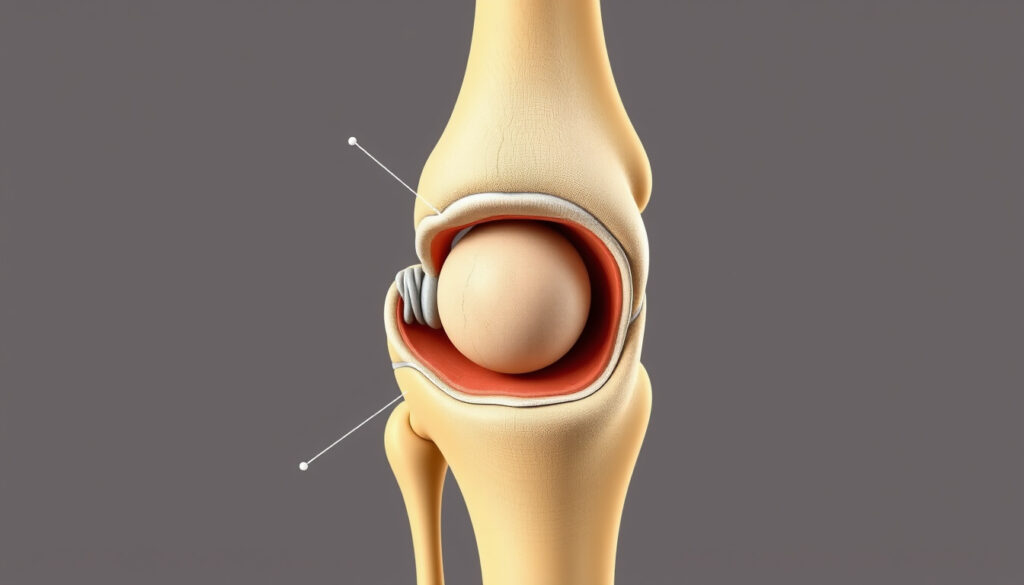
Ball and Socket Joint: Anatomy, Function, and Treatment
If you’ve ever had a shoulder pop after a long day of typing or felt a twinge in your hip climbing stairs, you already know where your ball and socket joints are. These two pairs of joints — the shoulder and hip — are the body’s most versatile, allowing movement in more directions than any other joint type. This article looks at how they work, what can go wrong, and what you can do about it.
Number in human body: 2 (shoulder and hip) ·
Range of motion: Multiaxial: flexion, extension, abduction, adduction, rotation, circumduction ·
Type of synovial joint: Spheroid joint ·
Examples: Glenohumeral joint (shoulder), hip joint
Quick snapshot
- Synovial joint where a rounded bone head fits into a cup-like socket (Radiopaedia (medical imaging encyclopedia))
- Allows multiaxial movement — three degrees of freedom (Kenhub (anatomy education platform))
- Only true examples: shoulder and hip joints (NCBI StatPearls (U.S. National Library of Medicine))
- Shoulder: head of humerus (ball) with glenoid fossa of scapula (socket) (Kenhub (anatomy education platform))
- Hip: head of femur (ball) with acetabulum of pelvis (socket) (Kenhub (anatomy education platform))
- Stabilized by ligaments (e.g., glenohumeral ligaments, iliofemoral ligament) and surrounding muscles (NCBI StatPearls (U.S. National Library of Medicine))
- Osteoarthritis — gradual cartilage wear (Cleveland Clinic (nonprofit medical center))
- Dislocation — especially shoulder due to shallow socket (Johns Hopkins Medicine (academic medical institution))
- Labral tears and bursitis (NCBI StatPearls (U.S. National Library of Medicine))
- Physical therapy to strengthen supporting muscles (Cleveland Clinic (nonprofit medical center))
- Anti-inflammatory medications and corticosteroid injections (Johns Hopkins Medicine (academic medical institution))
- Joint replacement (hip or shoulder arthroplasty) for advanced degeneration (NCBI StatPearls (U.S. National Library of Medicine))
Four key facts summarise the anatomy of ball and socket joints, one pattern: the shoulder prioritises mobility, while the hip prioritises stability.
| Label | Value |
|---|---|
| Number in body | 2 pairs (left and right shoulder and hip) |
| Maximum degrees of freedom | 3 rotational axes (flexion/extension, abduction/adduction, internal/external rotation) |
| Typical cartilage thickness | Hip: 2-4 mm; Shoulder: 1-2 mm |
| Largest ball and socket joint | Hip joint |
What is meant by ball-and-socket joints?
A ball-and-socket joint, also called a spheroid joint, is a synovial joint where the rounded head of one bone fits into the concave depression of another. The key defining feature: the ball can rotate freely inside the socket, enabling movement in all three planes.
Definition and anatomy
These joints are classified as polyaxial (multiaxial) synovial joints, offering more degrees of freedom than hinge, pivot, or condyloid joints. The articular surfaces are covered with hyaline cartilage, and the joint is enclosed by a capsule lined with synovial membrane. As described by Radiopaedia (medical imaging encyclopedia), the spheroid shape allows three degrees of freedom: flexion/extension, abduction/adduction, and internal/external rotation, plus circumduction.
How ball and socket joints work
- Flexion/extension: moving forward and backward (e.g., raising your arm forward, kicking your leg backward).
- Abduction/adduction: moving away from or toward the body midline.
- Rotation: turning the limb around its long axis (e.g., turning your palm up).
These movements are possible because the socket is shallow in the shoulder (glenoid cavity) and deeper in the hip (acetabulum). The trade-off: the shoulder sacrifices stability for range, while the hip sacrifices some range for stability. As the NCBI StatPearls (U.S. National Library of Medicine) notes, this structural difference explains why the shoulder dislocates far more often than the hip.
The shoulder’s shallow socket gives you the mobility to scratch any spot on your back, but it also makes the joint vulnerable to dislocation. The hip’s deep socket locks the femur in place at the cost of some rotational freedom.
The implication: Ball and socket joints are the body’s most mobile joints, but mobility comes at a price — the structures that stabilise them (ligaments, labrum, rotator cuff) are also the most frequently injured.
Where is your ball and socket joint?
Humans have exactly two true ball and socket joints, each appearing as a pair (left and right). They are located in the shoulder and hip.
Shoulder joint (glenohumeral)
- The head of the humerus articulates with the glenoid cavity of the scapula. The glenoid is shallow, like a golf ball sitting on a tee (Kenhub (anatomy education platform)).
- Stability is provided by the glenoid labrum (a fibrocartilage rim), the joint capsule, and the rotator cuff muscles.
- Active range: you can raise your arm 180° forward, abduct 180°, and rotate your arm nearly 90° internally and externally.
Hip joint (acetabulofemoral)
- The femoral head fits into the acetabulum of the pelvis. The acetabulum is deep and horseshoe-shaped, enclosing more than half of the femoral head (NCBI StatPearls (U.S. National Library of Medicine)).
- Strong ligaments (iliofemoral, ischiofemoral, pubofemoral) reinforce the capsule, limiting excessive movement.
- The hip typically flexes to 120°, extends 20°, abducts 45°, and rotates 40-60°.
Because the hip is so stable, pain or stiffness here often signals early arthritis rather than a dislocation. For the shoulder, sharp pain with overhead movement more often points to rotator cuff or labral issues.
The pattern: Both joints share the same ball-and-socket design, but their depth and ligament arrangement tailor them to different demands — the shoulder for overhead throwing, the hip for weight-bearing locomotion.
What are the 4 examples of ball and socket joints?
Strictly speaking, the human body only has two ball and socket joints — the shoulder and hip. But because each exists on both sides, some sources count four: left shoulder, right shoulder, left hip, right hip.
Human examples
- Glenohumeral joint (shoulder) — the most mobile joint in the body.
- Acetabulofemoral joint (hip) — the largest and most stable ball and socket joint.
No other human joint qualifies. The ankle? No — it’s a hinge joint. The wrist? A condyloid joint. As Brookbush Institute (continuing education for health professionals) explains, true spheroid joints allow motion around an indefinite number of axes with one common center, which only the shoulder and hip achieve in humans.
Other vertebrates
- In many mammals, the jaw joint (temporomandibular) has a ball-and-socket-like structure, though it’s technically a condylar joint.
- In birds, the hip and shoulder are also spheroid, adapted for flight.
- Some reptiles have ball and socket joints in their spine, allowing lateral undulation.
The term “4 examples” usually comes from counting each limb joint separately — a helpful mnemonic but not anatomically distinct types.
How do you treat a damaged ball/socket joint?
Treatment depends on which joint is damaged, the type of injury, and its severity. A simple sprain requires rest; a fractured femoral neck needs surgery. The Johns Hopkins Medicine (academic medical institution) emphasises that early intervention improves outcomes for both shoulder and hip injuries.
Conservative treatments
- Rest and activity modification — avoid the movements that aggravate pain.
- Physical therapy to strengthen the rotator cuff (shoulder) or gluteal muscles (hip).
- Nonsteroidal anti-inflammatory drugs (NSAIDs) such as ibuprofen to reduce pain and swelling.
- Corticosteroid injections for short-term relief in cases of bursitis or arthritis flare-ups.
Medical interventions
- Arthroscopy — a minimally invasive procedure to repair labral tears, remove loose bodies, or debride damaged cartilage.
- Biologic injections (platelet-rich plasma, hyaluronic acid) — evidence for long-term benefit is still evolving, but some patients report relief.
Surgical options
- Shoulder arthroplasty (replacement) for advanced arthritis or irreparable rotator cuff tears.
- Hip replacement (total hip arthroplasty) — one of the most successful orthopaedic surgeries, with 90-95% implant survival at 10 years according to registry data.
- Labral repair or reconstruction, especially in younger, active patients.
If you suspect a fracture or dislocation — sudden, severe pain with inability to move the joint — seek emergency care. Chronic, nagging pain warrants an orthopaedic evaluation.
Ball and socket joint problems rarely demand urgent surgery. For most people with arthritis, a combination of physical therapy, weight management, and injections can delay or avoid joint replacement for years.
The catch: Non-surgical treatment works best when started early. Waiting until the cartilage is completely gone leaves joint replacement as the only option.
Do ball & socket joints wear out?
Yes — and for the same reason they are so mobile: the constant friction between the ball and socket gradually thins the cartilage over time. This process is called osteoarthritis.
Arthritis and degeneration
- Osteoarthritis is the most common joint disorder worldwide, and hips and shoulders are frequent sites.
- Symptoms: pain with movement, stiffness after inactivity, reduced range of motion, and a grinding or clicking sensation (crepitus).
- Risk factors include age (>50), obesity, prior joint injury, genetics, and repetitive high-load activities.
Cleveland Clinic (nonprofit medical center) notes that while joint wear is common, many people with radiographic arthritis have no pain — structural change does not always equal symptoms.
When to see a doctor
- Pain that persists after two weeks of self-care (rest, ice, NSAIDs).
- Difficulty sleeping due to joint pain.
- Sudden inability to bear weight on the hip or raise the arm.
- Visible deformity or swelling.
A common confusion: “ball joint” in automotive contexts refers to a suspension component, not a human joint. If a car’s ball joint wears out, it is an urgent safety fix. For human ball and socket joints, degeneration is usually gradual and managed medically. However, a sudden dislocation or fracture is an emergency.
“Synovial joints are classified as diarthroses with free movement; ball-and-socket joints are the subtype with the greatest range of motion.”
— Cleveland Clinic (nonprofit medical center)
The consequence: For the average person, joint wear is a slow process. Maintaining a healthy weight and staying active preserves cartilage longer. For the athlete, the same joints that enable exceptional performance are also the first to show signs of overuse.
Related reading: Rotator Cuff Injury Test · Rotator Cuff Injury Test: At-Home Checks & Diagnosis
For a detailed look at the structure and movement of this joint, see this guide on ball and socket joint anatomy.
Frequently asked questions
Can ball and socket joints be replaced?
Yes. Total hip arthroplasty and total shoulder arthroplasty are common surgeries. Hip replacement has a 90‑95% success rate at 10 years; shoulder replacement also has excellent outcomes for arthritis (NCBI StatPearls (U.S. National Library of Medicine)).
What is the difference between a ball and socket joint and a condyloid joint?
Condyloid joints (e.g., wrist) allow movement in two planes (flexion/extension and abduction/adduction) but not rotation. Ball and socket joints allow all three planes including rotation (Kenhub (anatomy education platform)).
How do you strengthen a ball and socket joint?
Strengthen the muscles around the joint — rotator cuff exercises for the shoulder, glute and core work for the hip. Resistance training and controlled range‑of‑motion movements improve stability without overloading cartilage (Johns Hopkins Medicine (academic medical institution)).
What causes a ball and socket joint to pop?
Popping (crepitus) can come from gas bubbles in the joint fluid (cavitation), tendons snapping over bone, or roughened cartilage surfaces. It is usually harmless unless accompanied by pain or swelling.
Is a dislocated shoulder a ball and socket joint injury?
Yes. The shoulder is the most commonly dislocated ball and socket joint because its socket is shallow. Anterior dislocation (the humeral head moves forward) accounts for 95% of cases (NCBI StatPearls (U.S. National Library of Medicine)).
How long does hip replacement last?
Modern implants last 15–25 years in most patients. Younger, active patients may need a revision surgery later in life. Registry data show 90‑95% implant survival at 10 years.
Can arthritis affect ball and socket joints?
Yes. Osteoarthritis commonly affects the hip and shoulder. Rheumatoid arthritis and post‑traumatic arthritis also occur. Treatment ranges from physical therapy and injections to joint replacement (Cleveland Clinic (nonprofit medical center)).
Related reading
If you’re dealing with shoulder pain, a rotator cuff injury test can help you identify whether the issue is in the muscles or the joint itself. Early assessment makes a difference.
Ball and socket joints give us the freedom to swing a bat, climb stairs, and raise a glass. But that freedom is not free — the shoulder’s shallow socket and the hip’s load‑bearing role make both vulnerable to injury and wear. For the average person, the choice is clear: stay active, strengthen the supporting muscles, and seek help early. Ignoring the ache until the cartilage is gone only leaves one path — joint replacement.
More related posts
 Who Is Charlie Kirk? TPUSA Founder and Trump Ally Dies at 31
 Video Chat with Girls: Unverified Claims & Safety Tips
 Best TV Shows 2025: Top Picks and Most Watched Series
 Yankees vs Blue Jays 2026: ALDS History & Season Series
 Sarah J Maas Books in Order: Complete 2024 Reading Guide
 NZ Hot Sticky Weather – Causes, Forecasts and Coping Tips
 Things to Do in Taupo for Free: 21 Top Activities
 Houses for Rent in Melbourne: Prices, Suburbs & Tips