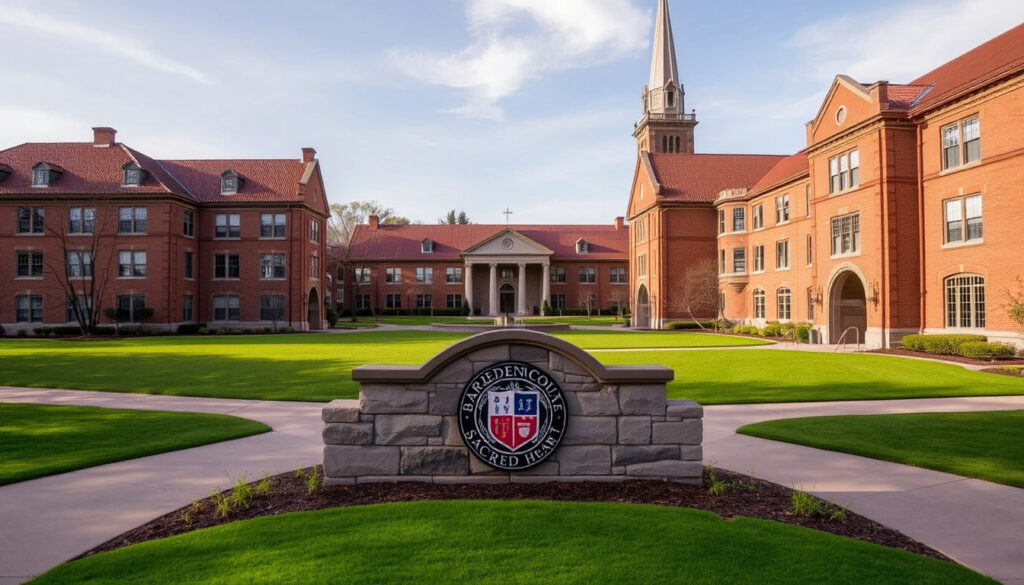
Baradene College of the Sacred Heart – Location, Fees, Admissions, History
Baradene College of the Sacred Heart stands as one of New Zealand’s longest-running Catholic girls’ schools, rooted in the educational philosophy of Saint Madeleine Sophie Barat. Located in the Auckland suburb of Remuera, the state-integrated institution has served students from Year 7 through Year 13 for over a century, cultivating academic excellence alongside spiritual and personal development.
The school operates as part of the Society of the Sacred Heart network, a global federation of schools established to nurture young women through holistic education. With a current enrollment exceeding 1,400 students, Baradene maintains its founding commitment to academic achievement while fostering community engagement and individual potential.
What is Baradene College of the Sacred Heart?
Baradene College of the Sacred Heart is a state-integrated Catholic girls’ secondary school situated in Remuera, Auckland. The institution educates students from Year 7 to Year 13, covering ages 11 through 18, and draws students from across the Auckland region. As a state-integrated school, Baradene operates under a partnership between the Catholic Church and the New Zealand Government, combining religious foundation with public funding.
School Type and Mission
The school traces its origins to the Religious Society of the Sacred Heart, an order founded by Saint Madeleine Sophie Barat in France in 1800. Baradene opened its doors in 1909, becoming part of an international network of Sacred Heart schools dedicated to educating young women within a framework of faith, academics, and service. The school’s motto, Cor unum et anima una in Corde Jesu, translates to “One Heart and One Mind in the Heart of Jesus,” reflecting its holistic approach to student development.
The institution emphasizes six dimensions of growth: spiritual, intellectual, emotional, social, cultural, and physical. This comprehensive philosophy shapes both classroom instruction and extracurricular offerings, aiming to develop well-rounded individuals prepared for higher education and civic life.
Years Offered
Baradene College accommodates students across seven year levels, from Year 7 through Year 13. The junior school years (7-8) focus on establishing foundational academic skills and adjusting to secondary school expectations. The middle and senior years (9-13) offer increasing specialization, preparation for national qualifications, and pathways to tertiary education. The school also welcomes approximately 50 international students annually, providing support for students from outside New Zealand.
- State-integrated Catholic school with over 115 years of operation
- Part of the international Society of the Sacred Heart network
- Socio-economic decile 9Q indicating strong community support
- Six houses for inter-house competitions including athletics and cultural events
- Emphasis on holistic development spanning spiritual to physical growth
- International student cohort of approximately 50 students
| Fact | Details |
|---|---|
| Principal (2025) | Alexandra Russell |
| Enrollment | 1,462 students (February 2024) |
| Socio-economic Decile | 9Q |
| Website | baradene.school.nz |
| Motto | Cor unum et anima una in Corde Jesu |
| International Students | Approximately 50 |
| Year Levels | 7-13 (ages 11-18) |
| School Houses | Six |
Where is Baradene College Located and How to Contact?
The school occupies a prominent site at 237 Victoria Avenue in Remuera, one of Auckland’s established residential suburbs known for its quality education options. The campus sits approximately 7 kilometres from the central business district, providing accessibility for families across the wider Auckland region. The physical address places the school within walking distance of Remuera’s village centre and near several public transport routes.
Address and Location Details
The campus spans coordinates 36°51′55″S 174°48′06″E, positioning the school in a valley area that offers spacious grounds while remaining connected to urban amenities. The address for postal correspondence differs from the physical location: students and families should use Private Bag 28 906, Remuera, Auckland 1541 for mail deliveries. The distinction between physical and postal addresses matters for navigation purposes versus document delivery.
Prospective families visiting the campus will find the grounds include historic buildings alongside modern facilities, with mature trees—particularly oak specimens—that feature in school traditions. The location in Remuera places students near other educational institutions, community facilities, and recreational spaces in one of Auckland’s more established suburbs.
Phone and Email
The main phone line for Baradene College is +64 9 524 6019. This number connects callers to the school’s administration office during standard business hours. For specific departments or academic enquiries, the office staff can direct calls appropriately. The school’s official website serves as the primary digital hub for information about admissions, upcoming events, and current news. Families interested in enrollment typically begin the process through the school’s official channels rather than third-party education platforms.
Baradene College Admissions and Fees
Enrollment at Baradene College follows the procedures typical of state-integrated schools in New Zealand, with particular consideration given to applicants who demonstrate connection to the Catholic faith and the Sacred Heart values. The admissions process prioritizes students whose families align with the school’s educational philosophy, though the school maintains an enrollment scheme that accommodates both faith-based and general applications depending on available spaces.
Enrollment Process
Prospective students apply through the school’s formal enrollment application, which typically requires submission of academic records, a birth certificate or passport, and evidence of Catholic baptism or commitment to Catholic education where applicable. The school publishes enrollment information through its official website, and families are encouraged to make contact well in advance of the intended start date, particularly for entry into Years 9 and 12 where demand often exceeds available places.
As a state-integrated institution, Baradene receives a portion of its funding from the government but supplements this through attendance dues and donations from families. International students pay different fees reflecting the full cost of education without government subsidy. For domestic students, the enrollment process includes acknowledgment of the attendance dues structure and the family’s commitment to supporting school activities and expectations.
Families considering enrollment should contact the school directly through the official website or main phone number to confirm current application requirements and available positions for their intended year level. The school typically conducts enrollment rounds with specific closing dates for each academic year.
Fee Structure for 2025
For New Zealand residents, Baradene College charges compulsory attendance dues that differ by year level. Years 7 and 8 students pay $532 per year in attendance dues, while students in Years 9 through 13 pay $1,080 per year. These amounts represent the mandatory component that families must contribute as part of the state-integrated arrangement.
Beyond compulsory dues, the school requests voluntary donations to support facilities, programs, and resources beyond the government-funded baseline. For 2025, requested donations stand at $4,940 annually for Years 7-8 students and $5,001 annually for Years 9 and above. While these donations are technically voluntary, they represent an important contribution to the school’s ability to maintain its facilities and offerings. Families experiencing financial difficulty should discuss payment arrangements with the school’s administration.
| Year Level | Compulsory Attendance Dues | Requested Donation |
|---|---|---|
| Years 7-8 | $532/year | $4,940/year |
| Years 9-13 | $1,080/year | $5,001/year |
History of Baradene College of the Sacred Heart
The establishment of Baradene College in 1909 marked the arrival of Sacred Heart education in New Zealand, brought to Auckland by the Society of the Sacred Heart. The order, founded by Saint Madeleine Sophie Barat in 1800 in France, had expanded across Europe and eventually to colonial territories including Australia and New Zealand. Baradene opened as a boarding and day school for girls, reflecting the Victorian-era practice of formal secondary education for young women from prosperous families.
Founding and Key Milestones
The year 1909 saw the first students walk through the school’s doors on what was then a semi-rural site at the edge of Remuera. The Society of the Sacred Heart had already established similar institutions worldwide, and Baradene adopted the standardized curriculum and values of the network while adapting to local conditions and the New Zealand education system. The school’s Latin motto, Cor unum et anima una in Corde Jesu, established from the beginning the spiritual foundation that would guide the institution.
The centenary celebration in 2009 marked 100 years of continuous operation, a significant achievement for any educational institution. By this milestone, Baradene had evolved from its founding era—characterized by uniforms of a different style and education more limited in scope—to a modern secondary school preparing students for university entrance and diverse career pathways. The transition from boarding school to primarily day school occurred gradually over the late twentieth century, reflecting broader social changes in New Zealand family life.
Leadership transitions have marked key periods in the school’s history. The school celebrated its previous principal Sandy Pasley, who led the institution for a decade, before welcoming Alexandra Russell as principal in 2025. This change represents the continuation of the tradition of leadership by individuals committed to Sacred Heart education and the holistic development of young women.
Baradene’s traditions include outdoor discussions held under historic oak trees on the campus, a practice that connects current students to the same spaces used by students over more than a century. The statue of Saint Madeleine Sophie Barat with a student symbolizes the personal mentorship central to Sacred Heart education.
Timeline of Baradene College
The evolution of Baradene College reflects broader changes in New Zealand education while maintaining continuity with its founding purpose. From its establishment in the early twentieth century through to contemporary operations, the school has adapted to changing educational standards, family expectations, and societal needs.
- 1909: Baradene College of the Sacred Heart opens its doors, established by the Society of the Sacred Heart as a boarding and day school for girls.
- 1950s-1970s: Expansion of facilities and curriculum as post-war education demand increases; gradual transition toward coeducational aspects in some programs.
- 2009: Centenary celebration marking 100 years of operation; publication of historical records and alumni events.
- 2010s: Continued investment in modern facilities while preserving heritage buildings; increase in international student enrollment.
- 2025: Principal Alexandra Russell assumes leadership, succeeding Sandy Pasley who served for a decade.
What Remains Clear and Unclear About Baradene College
Several aspects of Baradene College are well-documented through official sources and public records, while other details require direct inquiry with the school. Understanding this distinction helps prospective families set appropriate expectations when researching the institution.
The school’s founding date of 1909, Catholic foundation, location at 237 Victoria Avenue Remuera, current enrollment of 1,462 students, and fee structure for 2025 are all documented across multiple reliable sources. The principal transition to Alexandra Russell in 2025 appears in recent school communications and external references. Academic results from 2021 showing more than 97% university entrance rates are published through school reporting.
Specific details about the current enrollment process, waiting list procedures, and entry requirements for each year level have not been published in detail in the sources reviewed. Families should contact the school directly for enrollment applications and eligibility criteria. The 2025 NCEA results had not been published at the time of this research, with the most recent detailed academic data available from 2021.
Why Baradene College Stands Out in Auckland Education
The Auckland region hosts numerous secondary schools offering diverse educational approaches, from single-sex institutions to coeducational schools, from state provision to private establishments. Within this landscape, Baradene occupies a distinctive position as a state-integrated Catholic school with a long history and demonstrated academic outcomes. The combination of religious foundation, academic excellence, and reasonable fees compared to fully private schools creates a particular appeal for families seeking values-based education without full private school costs.
The school’s decile 9Q rating indicates a student population from relatively advantaged socioeconomic backgrounds, which correlates with strong community engagement and support for school activities. This does not imply exclusivity—state-integrated schools by definition serve the general community—but rather reflects the demographic characteristics of the Remuera area and the families who choose Catholic education for their daughters. The international student cohort adds cultural diversity to the campus community, exposing domestic students to global perspectives while providing pathways for overseas families seeking quality New Zealand education.
Academic Results and Achievements
Academic performance at Baradene College consistently exceeds national averages across New Zealand Qualifications Authority (NZQA) assessments. The 2021 results, representing the most recent detailed data available, demonstrate the school’s commitment to university preparation and comprehensive achievement across subject areas.
More than 97% of students who completed their final year at Baradene gained university entrance qualification, indicating successful preparation for tertiary study. The NCEA pass rate across Years 11 through 13 exceeded 99%, with more than 94% of students achieving Excellence or Merit endorsements—indicating above-average performance rather than mere competency. In scholarship examinations, Baradene students earned 50 scholarships with 6 classified as Outstanding, and two students received Outstanding Scholar Awards placing them among the top 50 students in New Zealand.
These outcomes reflect not only student effort and ability but also the effectiveness of the school’s teaching approaches and curriculum design. The combination of academic instruction with the broader development focus of Sacred Heart education appears to support students in achieving both measurable results and personal growth.
Uniform Policy and School Traditions
The Baradene College uniform includes distinctive elements that reinforce school identity and community belonging. Students wear straw boater hats as part of the formal uniform, a tradition that connects current students to generations of past pupils. The uniform for daily wear typically includes the school skirt, blazer, and hat, with specific requirements published through the school office and student handbook.
School traditions extend beyond dress to encompass ceremonial occasions and everyday practices. The tradition of holding outdoor discussions under the historic oak trees on campus creates a distinctive learning environment and connects academic activity to the natural surroundings. The statue of Saint Madeleine Sophie Barat with a student—a common feature in Sacred Heart schools worldwide—serves as a visual reminder of the personal, relational approach to education that characterizes the institution. These traditions foster continuity between generations of students and reinforce the values emphasized in the school’s mission.
Sources and References
Information about Baradene College of the Sacred Heart derives from multiple sources representing different perspectives on the institution. The school’s official website provides current information about operations, contacts, and news, while external databases and publications offer additional context.
“A school with heart” feature in Verve Magazine documented student life, traditions, and the school’s distinctive approach to Catholic education in 2024.
Educational directories including EdaRabia and Kiddle compiled basic institutional data including enrollment figures, location, and historical information.
The Wikipedia entry for Baradene College of the Sacred Heart provided foundational information corroborated by other sources. The official Baradene College website serves as the primary source for current enrollment procedures and contact information.
Summary
Baradene College of the Sacred Heart represents a significant option for families seeking Catholic girls’ education in Auckland. Founded in 1909 and operated by the Society of the Sacred Heart, the school combines over a century of educational tradition with contemporary academic outcomes. The state-integrated model makes quality Catholic education accessible at fees substantially below fully private school costs, while the school’s decile 9Q rating and demonstrated NCEA results indicate strong academic performance. With 1,462 students across Years 7-13 and a principal transition to Alexandra Russell in 2025, the institution continues its mission of holistic development rooted in the values of Saint Madeleine Sophie Barat.
Families considering enrollment should engage directly with the school through its official channels to obtain current information about the application process, available positions, and specific requirements for their situation.
Frequently Asked Questions
What academic results does Baradene College achieve?
In 2021, more than 97% of Baradene leavers gained university entrance. The NCEA pass rate exceeded 99% for Years 11-13, with over 94% achieving Excellence or Merit endorsements. The school also recorded 50 scholarships including 6 Outstanding Scholar Awards.
What is the uniform policy at Baradene College?
Baradene students wear a formal uniform including a straw boater hat, blazer, and school skirt. Specific uniform requirements and purchasing information are available through the school office. The boater hat tradition connects current students to the school’s history.
How many students attend Baradene College?
The school enrolled 1,462 students as of February 2024, including approximately 50 international students. The enrollment spans Years 7 through 13, covering ages 11 to 18.
What is the history of Baradene College?
Baradene College was established in 1909 by the Society of the Sacred Heart, celebrating its centenary in 2009. The school was founded on the educational philosophy of Saint Madeleine Sophie Barat and has operated continuously for over 115 years.
Who is the current principal of Baradene College?
Alexandra Russell became principal in 2025, succeeding Sandy Pasley who led the school for a decade. Russell leads an institution with over 1,400 students and a staff committed to the Sacred Heart educational mission.
What are the attendance dues at Baradene College for 2025?
Compulsory attendance dues are $532 per year for Years 7-8 and $1,080 per year for Years 9-13. The school also requests voluntary donations of $4,940 (Years 7-8) and $5,001 (Years 9+) annually.
Is Baradene College a Catholic school?
Yes, Baradene College is a Catholic girls’ school operated by the Society of the Sacred Heart. The school follows the motto “Cor unum et anima una in Corde Jesu” (One Heart and One Mind in the Heart of Jesus) and emphasizes spiritual development alongside academic achievement.
What years does Baradene College cater for?
Baradene College educates students from Year 7 to Year 13, covering secondary education from ages 11 through 18. The school is structured with distinct programs for junior, middle, and senior secondary students.
More related posts
 Westpac Home Loan Rates – Current NZ Specials and Comparisons
 Symptoms of Bowel Cancer: 5 Warning Signs & When to Seek Help
 New Swimming Pool Christchurch: Parakiore Open Now
 Chainsaw Man Season 2 – Official Announcement and Key Details
 Homes for Sale Whangarei: Private, Rural & Cheap Listings
 Country Starting with O: Oman and Rare Letter Facts
 NZ Herald News Today 2025: Breaking News & Headlines
 What Is the No Kings Protest? 8M Turnout in 3 Major Waves