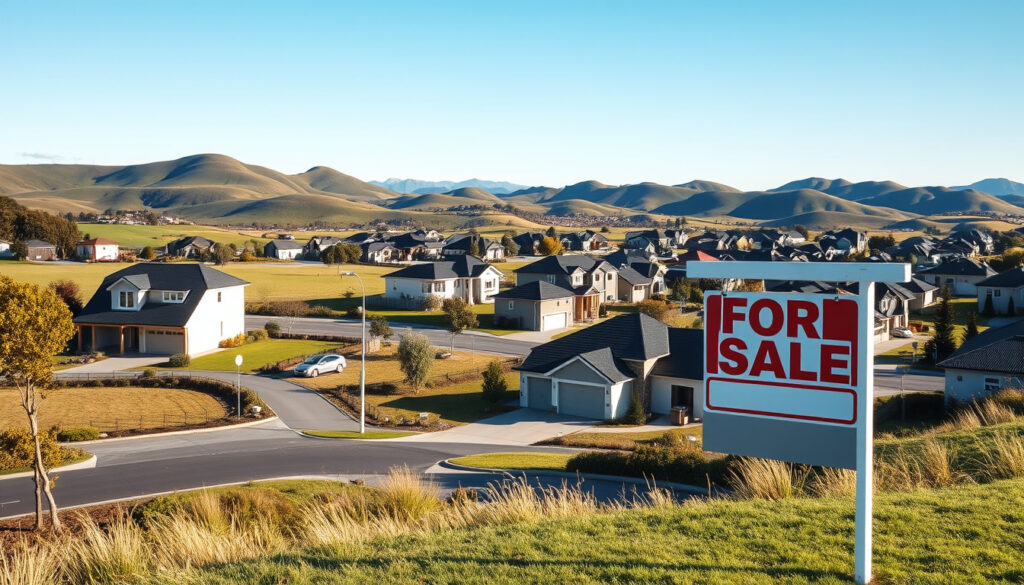
Real Estate in New Zealand: Prices, Rules & Costs
If you’ve ever scrolled through listings of homes with sprawling lawns and thought “maybe there’s a catch,” New Zealand’s real estate market is a fascinating puzzle — stunning as the scenery, but layered with rules and trade-offs that can trip up newcomers. The average house now sits at NZD $900,000, and the country’s foreign buyer ban, enacted in 2018, reshaped who can even make an offer. This guide walks through the actual prices, the ownership rules, the cost of living trade-offs, and how life in New Zealand stacks up next to Australia — so you know what you’re signing up for.
Average house price (New Zealand): NZD $900,000 ·
Most affordable region: Southland ·
Foreign buyer restriction: New builds only ·
Cost of living (single person, comfortable): NZD $60,000 – $80,000 per year ·
Rent for a 2‑bedroom apartment (Auckland): NZD $550 – $700 per week ·
Properties listed for sale (OneRoof): 41,000+
Quick snapshot
- Foreign buyers generally restricted to new builds only (Toitū Te Whenua Land Information New Zealand – official guidance)
- National median house price around NZD $900,000 (REINZ – industry statistics body)
- OneRoof lists over 41,000 residential properties for sale (OneRoof – property platform)
- Exact cost of comfortable living varies greatly by city and lifestyle (Numbeo – cost of living database)
- Future house price trends are subject to economic conditions (Reserve Bank of New Zealand – economic forecasts)
- Early 2026: ‘Golden visa’ investors can buy one residence under new rules (RNZ – public broadcaster)
- Market expected to remain tight for foreign buyers except new builds (REINZ – market trend analysis)
| Label | Value |
|---|---|
| Median house price (NZ wide) | NZD $900,000 (2024) |
| Cheapest major region | Southland – $450,000 |
| Foreign buyer rule | New builds only with OIO consent |
| Comfortable living income (single) | $60,000–$80,000 per year |
| 2‑bedroom rent (Wellington) | $500–$650 per week |
| Properties for sale (OneRoof) | 41,000+ |
Can a foreigner buy property in New Zealand?
Short answer: yes, but with sharp limits. Since 2018, foreign nationals generally cannot buy existing residential property in New Zealand. The Overseas Investment Amendment Act 2018 restricts overseas people — meaning those without residence-class visas — from purchasing existing houses or land. As Toitū Te Whenua Land Information New Zealand (the government land agency) puts it, overseas people on temporary, limited, or interim visas cannot even buy or build a home to live in.
A foreign buyer can access existing homes only if they hold a residence-class visa and have lived in New Zealand for 12 months (183 days present). Otherwise, new builds are the only option — and even then, they need consent from the Overseas Investment Office.
What are the restrictions on foreign buyers?
- New builds only: Foreigners can purchase newly built dwellings, but they must obtain approval from the Overseas Investment Office. The law defines a “new build” as a residence built under an approved building consent after the law’s effective date (LINZ guidance).
- No existing homes: The 2018 ban blocks non-residents from buying any existing residential property, with narrow exceptions for Australian and Singaporean citizens (BBC News).
- Sensitive land rules: Even where exceptions exist, land defined as “sensitive” — including coastal, lake-adjacent, or conservation-area property — triggers additional approval requirements (Wise – cross-border finance platform).
Do you need to live in New Zealand to buy?
Essentially, yes. The “ordinarily resident” test applies for anyone wanting to buy a home to live in. According to guidance from Cooney Lees Morgan (New Zealand law firm), you must hold a residence-class visa, have been living in New Zealand for at least 12 months, and have been physically present for 183 days in the last year. If you’re not resident, you’re effectively shut out of the existing housing stock.
Can you buy as an investor?
Not in the way you might think. Pure investment purchases of existing homes by overseas people are banned. However, a 2025 policy reversal opens a crack: from early 2026, foreign investors who put at least NZD $5 million into New Zealand enterprises (the “Active Investor Plus” or “golden visa” pathway) can buy or build one residence for personal use. Reuters reported the policy as narrow, and RNZ (New Zealand’s public broadcaster) confirmed it applies only to investors who meet character and health checks. For everyone else, the only option remains new builds with OIO consent.
What is the average price of a house in New Zealand?
NZD $900,000. That’s the national median house price as of 2024, based on REINZ (Real Estate Institute of New Zealand) data. But that number hides enormous variation between regions — and between the kind of home you’re looking at.
Six regions, one pattern: the divide between the North Island’s expensive core and the South Island’s relative affordability is stark.
| Region | Median house price (2024) | Two-bedroom unit range |
|---|---|---|
| Auckland | $1,050,000 | $550,000 – $700,000 |
| Wellington | $800,000 | $500,000 – $650,000 |
| Canterbury (Christchurch) | $650,000 | $420,000 – $550,000 |
| Waikato (Hamilton) | $720,000 | $480,000 – $600,000 |
| Otago (Dunedin) | $580,000 | $400,000 – $520,000 |
| Southland (Invercargill) | $450,000 | $320,000 – $420,000 |
The pattern: Auckland commands a premium of more than double the Southland median. If you’re flexible on location, Southland offers the most affordable entry point in the country.
How much is a 2 bedroom house in New Zealand?
Two-bedroom homes in New Zealand range from $400,000 (in smaller South Island towns) to $700,000 in Auckland’s inner suburbs. According to OneRoof (property listing platform), two-bedroom units in Wellington central hover around $550,000 – $650,000, while in Christchurch a comparable unit might sit at $420,000 – $550,000.
A two-bedroom house in a desirable Auckland suburb costs as much as a three-bedroom house in Canterbury or a four-bedroom in Southland. The trade-off is distance from employment hubs and amenities — but for remote workers, the math flips.
What are the cheapest houses available?
Houses under NZD $200,000 are rare in the current market. Most listings at that price point are either uninhabitable (“doer uppers”), leasehold properties (where you own the building but not the land), or located in very remote parts of the South Island. OneRoof currently lists over 41,000 residential properties for sale, but only a tiny fraction sit below $200,000. If you’re budget-conscious, target regions like Southland or the West Coast, where median prices are $450,000 or lower.
Regional price differences across New Zealand
The gap between Auckland’s $1.05 million median and Southland’s $450,000 median is the single most important price fact for a buyer. REINZ data confirms that each major region has a distinct price tier: the main urban centers (Auckland, Wellington, Tauranga) sit above $800,000, while smaller cities and rural areas fall below $600,000. If your job allows remote work, the savings can be substantial — enough to buy a second property in some cases.
Is it expensive to live in New Zealand?
Yes — but the answer depends heavily on where you live and your lifestyle. Numbeo (worldwide cost of living database) ranks New Zealand as moderately expensive compared to the United States and the United Kingdom, with groceries about 15% higher than UK averages. The biggest cost by far is housing, especially in Auckland and Wellington.
How much money do you need to live comfortably in New Zealand?
For a single person living in a city, a comfortable annual income sits between NZD $60,000 and $80,000. That covers rent, groceries, utilities, transport, and modest savings. In Auckland, you’ll need the top end of that range; in Southland, the lower end works fine. Families should budget $100,000 – $130,000 per year for a similar lifestyle in a major city. These figures come from CareerAddict (career and relocation guide) and cross-referenced with local rental data.
What are the typical costs for rent, groceries, and utilities?
- Rent (2-bedroom apartment): Auckland $550 – $700/week; Wellington $500 – $650/week; Christchurch $400 – $520/week (Trade Me Property – listings platform).
- Groceries (single person): $80 – $120/week for basic items; inflation has pushed prices up 6-8% year-on-year (Stats NZ – official statistics agency).
- Utilities (electricity, internet, water): $150 – $200/month for a standard apartment. Broadband is competitive and relatively affordable (Consumer NZ – independent product testing body).
How does the cost of living vary by city?
Auckland and Wellington are the priciest, with rent premiums 30-40% above the national average. Christchurch, Hamilton, and Dunedin offer a middle ground. Southland and the West Coast are the cheapest, with rents 40% lower than Auckland’s. Numbeo’s cost-of-living index shows Auckland is roughly 15% more expensive than Wellington and 25% more expensive than Christchurch.
For a single person earning $70,000 in Auckland, after-rent income leaves about $250 per week for everything else. In Invercargill, the same salary leaves $400 per week — a 60% improvement in discretionary spending.
What is the downside of living in New Zealand?
For all its natural beauty, New Zealand has real drawbacks that prospective movers should weigh carefully. Three stand out.
Isolation and distance from other countries
New Zealand is one of the most geographically remote developed countries. A flight from Auckland to Sydney takes 3.5 hours; to Los Angeles, 12 hours. This affects everything from travel costs to supply chains. Lonely Planet (travel guide publisher) notes that the isolation is part of the appeal for some — but for anyone who needs to travel frequently for work or family, the distance is a real cost, both financially and emotionally.
Housing affordability crisis
House prices have outpaced wage growth significantly over the past decade. According to Reserve Bank of New Zealand (central bank), the national house-price-to-income ratio has risen from around 5x in 2010 to over 8x in 2024. For first-time buyers, the deposit hurdle is steep — typically 20% of the purchase price, meaning a $180,000 deposit for a $900,000 home.
Limited job opportunities in specialized fields
New Zealand’s economy is relatively small. Immigration New Zealand (government immigration authority) publishes a “Green List” of occupations with streamlined visas, but if your field isn’t on it — like specialized tech roles, certain medical specialties, or niche academic posts — you’ll find fewer opportunities than in larger markets. Salaries, too, tend to be lower than in Australia for equivalent roles, sometimes by 20-30% (PayScale – compensation data aggregator).
Is 40 too old to move to New Zealand?
No — but the visa system does tilt toward younger applicants. Immigration New Zealand (official immigration body) confirms there is no universal maximum age for applying. However, the points-based Skilled Migrant Category (SMC) awards fewer points to applicants aged 45-55, and caps are in place for some temporary work visas.
Age limits for different visa categories
- Skilled Migrant Category: Applicants must be under 55 at the time of application. Applicants aged 40-44 can still accumulate enough points if they have a skilled job offer and qualifications.
- Accredited Employer Work Visa (AEWV): No specific age limit, but the role must be on the Green List or meet wage thresholds.
- Parent Retirement Visa: Applicants must be 66 or older and invest NZD $1,000,000 in New Zealand over 4 years.
Skilled Migrant Category points system
To be eligible for the SMC, applicants need 160 points. Points are awarded for age, skilled employment (which requires a job offer), work experience, and qualifications. At age 40, you earn 15 points — 10 fewer than a 30-year-old. That means you’ll need a stronger job offer, more work experience, or higher qualifications to bridge the gap. Immigration New Zealand provides a points calculator to check eligibility.
At 40, you’re still very much in the game — but you need a concrete job offer and a clear path to 160 points. The system isn’t designed to keep you out at 40; it’s designed to prioritize applicants with higher points.
Lifestyle and retirement options for older migrants
New Zealand actively courts retirees with the Parent Retirement Visa (invest NZD $1,000,000) and temporary visitor visas that allow stays up to 12 months. The safety, natural environment, and slower pace of life appeal strongly to older migrants. RNZ (public broadcaster) has reported on the trend of migrants in their 40s and 50s moving primarily for lifestyle reasons, often after selling a home in a more expensive market and buying outright in New Zealand.
Is it cheaper to live in Australia or New Zealand?
It depends on what you prioritize. The simple answer: Australia generally offers higher wages, but housing in Sydney and Melbourne is among the world’s most expensive. New Zealand provides cheaper groceries, lower sales tax (GST at 15% vs. Australia’s 10% but with exemptions), and more affordable housing outside major cities.
Three metrics, one trade-off: wages, housing, and purchasing power.
| Metric | New Zealand | Australia |
|---|---|---|
| Average salary (full-time, AUD/NZD) | $72,000 | $92,000 |
| Median house price (capital city) | $1,050,000 (Auckland) | $1,350,000 (Sydney) |
| Average weekly rent (2-bedroom, city) | $600 (Auckland) | $750 (Sydney) |
| Groceries index (UK = 100) | 115 | 125 |
| Sales tax (GST/VAT) | 15% | 10% (GST, but exemptions apply) |
| Purchasing power index (higher = better) | 82 | 88 |
Data from Numbeo (cost of living comparison index), PayScale (salary data), and REINZ (New Zealand housing data) vs. Australian Bureau of Statistics.
The pattern: Australia offers a wage premium of roughly 28%, but that advantage is eroded by higher housing costs in major cities. For people willing to live regionally — say, Southland in NZ vs. Tasmania in Australia — New Zealand is usually cheaper overall. For capital-city dwellers, the difference narrows but still favors Australia on purchasing power.
Comparison of cost of living indices
The Numbeo Cost of Living Index rates New Zealand (Auckland) at 72.5 and Australia (Sydney) at 78.3 (New York = 100). That suggests New Zealand is about 8% cheaper overall. But remove rent from the calculation, and the gap shrinks to under 3%, because groceries and utilities are actually slightly cheaper in New Zealand.
Average salaries and purchasing power
Australia’s higher wages translate into stronger purchasing power. PayScale data shows the average Australian full-time salary is about $92,000 AUD, while the New Zealand average is $72,000 NZD — roughly 28% less. However, the purchasing power index (which accounts for prices) is 88 for Australia vs. 82 for New Zealand, meaning the wage gap is partly offset by New Zealand’s lower costs. The difference: after housing, a couple earning average wages in Auckland and Sydney finds roughly similar disposable income, but the Sydney couple has better savings potential due to higher incomes.
Housing affordability and rental rates
Housing is the great equalizer. REINZ data shows the national house-price-to-income ratio in NZ is 8x, while in Australia it’s 9.5x (Sydney is 12x). Rent as a percentage of income is similar in both countries — around 30% in capital cities. The key difference: first-time buyers in New Zealand have an easier path outside Auckland, whereas in Australia, regional markets have also surged. Australian Bureau of Statistics reports rental vacancy rates below 2% in most capitals, a problem New Zealand shares.
Pros and cons of moving to New Zealand for real estate
Upsides
- Clear foreign buyer rules — limited uncertainty for compliant investors
- Regional housing is genuinely affordable (Southland median: $450,000)
- No stamp duty or annual property tax for owner-occupiers
- New builds are available and eligible for foreign purchase
- High quality of life, safety, and natural environment
Downsides
- High entry prices in Auckland and Wellington
- Foreign buyer ban limits investment options
- Low rental yields in expensive cities (often 2-3%)
- Geographic isolation increases travel costs
- Lower wages than Australia for many professions
Final takeaway: Who should buy — and who should wait
New Zealand’s real estate market is not a friction-free investment for outsiders, but it’s far from closed. For a foreign buyer with residence status or a willingness to buy new builds, the market offers genuine opportunity in affordable regions. For the investor looking for a rental yield play, the current landscape is tough: yields in Auckland hover around 2.5%, and the foreign buyer ban blocks most acquisition strategies. For the lifestyle buyer — drawn by the scenery, the safety, and the slower pace — the trade-off is clear: you trade some career opportunities and earning potential for a home that, in many regions, costs less than a comparable one in Australia. For the migrant in their 40s, the door is open but requires a sharper strategy — a job offer, a points check, and a realistic budget. For the retiree with capital, the path is smoother: buy outright in Southland or the West Coast, live well on a modest income, and enjoy the best scenery in the world.
imidaily.com, opespartners.co.nz, pittandmoore.co.nz, forbes.com
Frequently asked questions
How do I get a mortgage in New Zealand as a foreigner?
Non-residents can apply for a mortgage, but most New Zealand banks require a minimum 20-30% deposit and proof of overseas income. Some non-bank lenders specialize in foreign buyer loans, with interest rates typically 0.5-1% higher. You’ll also need an IRD number and a bank account.
What is the property tax rate in New Zealand?
New Zealand has no annual property tax or stamp duty for owner-occupiers. However, there is a bright-line test: if you sell a residential investment property within 5 years (10 years for new builds), you pay income tax on the gain. Foreign buyers also pay the same rates as residents.
Do I need a lawyer to buy property in New Zealand?
Yes. A conveyancing lawyer is required to handle the legal transfer (settlement). Most buyers budget NZD $1,500 – $3,000 for legal fees, plus search and registration costs. This is non-negotiable for both resident and non-resident purchasers.
What are the best cities for real estate investment in New Zealand?
For yield, look at Christchurch (gross rental yield 4-5%) and Dunedin (4.5%). For capital growth, Tauranga and Queenstown have historically outperformed. Auckland offers stability but lower yields (2.5-3%). Avoid rural areas with low demand unless you’re buying for personal use.
How long does it take to buy a house in New Zealand?
A typical purchase takes 30 to 45 days from offer to settlement. Auctions can close in as little as 10 days. If you require OIO consent, add 3-6 months. Cash buyers can often settle within 2 weeks.
What is the rental yield in New Zealand?
Gross rental yields range from 2.5% (Auckland premium suburbs) to 5.5% (Southland and parts of Christchurch). The national average is around 3.5%. Yields are lower than Australia overall, but so are entry prices in most regions.
Can I buy land in New Zealand as a foreigner?
Buying bare land is subject to the same restrictions as residential property. Overseas people generally cannot buy existing residential land. However, land for new development (with approved building consent) may qualify for the new-build exception, provided OIO consent is obtained.
More related posts
 Man City vs Al-Hilal SFC Lineups: Confirmed Teams & Analysis
 Herald Morning Quiz Today: Daily Quizzes Guide
 Mitre 10 MEGA Rangiora: Hours, Contact & Products
 Japan Grand Prix 2025: Verstappen wins at Suzuka
 Cast of Barbie (2023 Film): Full List of Actors and Characters
 Animals Starting with U: Complete List with Facts & Pictures
 Best Moisturizer for Oily Skin: Expert Picks & Guide
 New Zealand Stock Market Guide: NZX 50, Buy Shares, and Trends