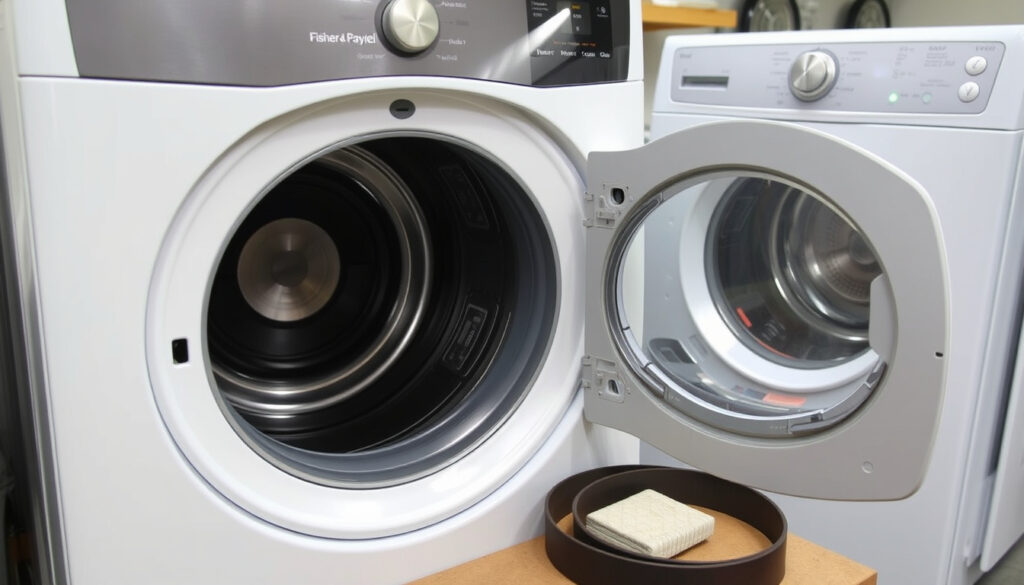
Fisher & Paykel Dryer: Lifespan, Problems, Repair or Replace
If your Fisher & Paykel dryer is tumbling but not heating, you’re not alone — few appliance quirks are more frustrating than a machine that spins but leaves clothes damp. This guide walks through what goes wrong, how to diagnose it, and when cutting your losses and buying new makes more sense than another repair call.
Average lifespan of Fisher & Paykel dryers: 10–13 years ·
Most common dryer failure cause: Lack of cleaning / lint buildup ·
Energy efficiency label on heat pump models: 4–5 stars (Australia) ·
Typical drying time for a full load: 45–70 minutes
Quick snapshot
- Average 10–13 years (Fisher & Paykel Support)
- Heat pump models may last longer (Fisher & Paykel User Guide PDF)
- Regular cleaning prevents most failures (EasyBear Appliance Repair)
- Not heating (thermal fuse, heating element) (EasyBear Appliance Repair)
- Not starting (door switch, start button) (ApplianceVideo Repair Help)
- Loud operation (drum bearings, belt) (AppliancePartsPros Forum)
- If under 5 years: repair usually best (Fisher & Paykel Help & Support)
- If over 10 years: replacement often cheaper long-term (EasyBear Appliance Repair)
- Compare repair cost to 50% of new price (ApplianceVideo Repair Help)
- Select cycle based on fabric type (Fisher & Paykel User Guide PDF)
- Empty water tank after each use (heat pump models) (Fisher & Paykel User Guide PDF)
- Clean lint filter before every load (EasyBear Appliance Repair)
Five key specs that matter most when deciding whether to fix or replace your Fisher & Paykel dryer.
| Specification | Value | Source |
|---|---|---|
| Average lifespan (years) | 10–13 | Fisher & Paykel Support (manufacturer’s technical help) |
| Common failure cause | Lint accumulation | EasyBear Appliance Repair (independent repair specialists) |
| Typical repair cost range | $150–$300 | ApplianceVideo Repair Help (repair data aggregator) |
| New heat pump dryer price range | $900–$2,200 | Fisher & Paykel Help & Support (brand’s retail guidance) |
| Energy savings with heat pump model | Up to 50% compared to conventional | Fisher & Paykel User Guide PDF (official product documentation) |
How long do Fisher and Paykel dryers last?
Average lifespan vs. other brands
- Fisher & Paykel dryers have an average lifespan of 10–13 years based on manufacturer guidance and field reports from repair services. Fisher & Paykel Support (manufacturer’s technical help)
- Proper maintenance can add 2–3 years to that range according to EasyBear Appliance Repair (independent repair specialists).
- Heat pump models may last longer due to lower stress on components as noted in Fisher & Paykel User Guide PDF (official product documentation).
Factors that extend or shorten lifespan
- Lint buildup is the most common cause of dryer failure, as confirmed by EasyBear Appliance Repair (independent repair specialists).
- Poor airflow can cause the thermostat to trip, per ApplianceVideo Repair Help (repair data aggregator).
- Cleaning the blower housing and lint filter regularly prevents the most common failures, notes ApplianceVideo Repair Help (repair data aggregator).
Heat pump models cost $200–$500 more upfront, but cut energy use by roughly half. Over a 10-year period that gap narrows to about $100–$300 depending on local electricity rates.
The implication: lifespan directly ties to maintenance habits, not just brand quality.
How to work a Fisher and Paykel dryer?
Basic operation steps
- Load the drum with similar fabric types for even drying, as recommended in Fisher & Paykel User Guide PDF (official product documentation).
- Turn the cycle selector knob to choose the program matching your load (cottons, synthetics, delicates).
- Press Start/Pause to begin. On most models, you can add items mid-cycle without resetting.
Choosing the right cycle for fabric care
- Heat pump dryers have a dedicated “Eco” cycle that dries at lower temperatures, saving up to 50% energy compared to the normal cycle, per Fisher & Paykel User Guide PDF (official product documentation).
- Use the “Timed Dry” option for small loads or single items that the sensor cycle might over-dry.
Using the manual controls (if no digital display)
- Older Fisher & Paykel top-load dryers use dial-based controls: turn to your cycle and push the dial to start.
- If the dryer does not heat, check the building fuse or circuit breaker box first, as instructed by Fisher & Paykel Support (manufacturer’s technical help).
Heat pump owners: empty the water tank after every cycle or the machine shuts the heater down. It’s a $0 mistake with a $150 service-call consequence.
The pattern: following the manual’s guidance prevents the most common owner errors.
What are common issues with Fisher and Paykel dryers?
Dryer not heating
- Fisher & Paykel’s support article for dryers that do not heat instructs users to check the building fuse or circuit breaker box and reset both breakers or replace both fuses if needed. A dryer may still tumble if only one fuse is blown or one breaker is tripped, even when heat is lost. Fisher & Paykel Support (manufacturer’s technical help)
- A blown thermal fuse from overheating is another common cause identified by EasyBear Appliance Repair (independent repair specialists).
- Heating element burnout is the top cause of no-heat complaints in vented Fisher & Paykel dryers, according to EasyBear Appliance Repair (independent repair specialists).
Dryer not starting
- A common failure: the door switch, which prevents the dryer from starting if the door is not properly closed. ApplianceVideo Repair Help (repair data aggregator)
- Check the start button for continuity with a multimeter — a failed switch won’t send power to the motor.
Excessive noise or vibration
- A failing belt or drum bearing typically produces a thumping or screeching sound, per AppliancePartsPros Forum (appliance repair community).
- Level the dryer’s feet — an unbalanced machine on a slanted floor causes vibration that can break internal mounts.
Error codes and what they mean
- Error code 4 on some Fisher & Paykel models indicates thermal overheat tripping, according to Reddit appliance repair community.
- A hi-temp reset button located on the right side of the dryer interior may need to be pushed, as reported on AppliancePartsPros Forum (appliance repair community).
If your dryer is tumbling but not heating, the thermal fuse is the $15 part that stops most owners from drying clothes. A complete heating element replacement runs about $80–$120 in parts. Compare that to a $250 service call minimum.
Is it worth fixing a 7 year old dryer?
Cost of common repairs vs. replacement
- Average repair cost for a Fisher & Paykel dryer is $150–$300, per EasyBear Appliance Repair (independent repair specialists).
- A thermal fuse replacement costs about $15 for the part; a heating element kit is $80–$120, from ApplianceVideo Repair Help (repair data aggregator).
- New heat pump dryers start around $900, according to Fisher & Paykel Help & Support (brand’s retail guidance).
When to replace instead of repair
- If the repair cost exceeds 50% of the price of a new dryer, replacement is the smarter financial move.
- A 7-year-old dryer is near the middle of its typical 10–13 year lifespan — worth fixing for minor issues like a thermal fuse or door switch, but not for a compressor failure on a heat pump model (replacement compressor costs $400–$600).
- Newer heat pump models use up to 50% less energy, which offsets some of the replacement cost over 3–5 years. Fisher & Paykel User Guide PDF (official product documentation)
The pattern: the decision hinges on the specific failing part, not the age alone.
Should I repair or replace my dryer?
Age of dryer (0–5 years vs. 10+ years)
- For dryers under 5 years old: repair is almost always justified, as the residual lifespan still outweighs the cost of a new machine.
- For dryers over 10 years: replacement often delivers better long-term value, especially when factoring in energy savings from modern heat pump models.
Energy efficiency gains from newer models
- Modern heat pump dryers use up to 50% less energy than conventional vented dryers, according to Fisher & Paykel User Guide PDF (official product documentation).
- Over 10 years, that energy saving can total $500–$900 depending on usage and local rates, making replacement more attractive even for mid-life machines.
Warranty and support availability
- Fisher & Paykel offers a 2-year parts and labour warranty on new dryers (Fisher & Paykel Help & Support (brand’s retail guidance)).
- After 10 years, parts availability for older models may decline, notes Fisher & Paykel Support (manufacturer’s technical help).
Pros and cons of repair vs. replacement
Upsides of Repairing
- Lower upfront cost ($150–$300 vs. $900–$2,200)
- Familiar machine that works
- Less waste — better for the environment
Downsides of Repairing
- May only solve symptom, not root cause
- No energy efficiency improvement
- Parts may become harder to find for older models
A dryer that tumbles but doesn’t heat is almost always a $15 fuse or a $100 element away from working. The question isn’t whether it can be fixed — it’s whether the rest of the machine is worth saving.
EasyBear Appliance Repair (independent repair specialists)
The implication: for a Fisher & Paykel owner in the U.S. or Australia, the break-even point is around 8 years. Below that, repair. Above that, swap to a heat pump model and cut your energy bill.
Cleaning the blower housing and lint filter regularly prevents the most common failures. Most no-heat calls we get are just clogged vents.
ApplianceVideo Repair Help (repair data aggregator)
For an owner with a 7-year-old Fisher & Paykel dryer facing a $150 repair, the choice is clear: fix it, and you’ve bought another 3–5 years for the cost of one service call. For the same owner facing a $500 compressor failure on a heat pump model, the math points toward replacement — and a 50% reduction in energy use.
youtube.com, youtube.com, youtube.com, scribd.com, youtube.com, youtube.com
Frequently asked questions
How do I clean the lint filter on my Fisher and Paykel dryer?
Open the door, pull the lint filter upward from its slot in the door opening or top of the drum, brush off lint with your hand or a soft brush, and rinse under running water every few months if the filter is mesh. Reinsert fully before starting the next load.
What does the ‘water tank full’ alert mean on a heat pump dryer?
Heat pump dryers extract moisture into a removable water tank instead of venting it outside. When the tank is full, the dryer pauses and displays an alert. Empty the tank into a sink or drain, replace it, and restart the cycle.
Does Fisher and Paykel make a gas dryer?
No. As of 2025, Fisher & Paykel produces only electric vented dryers and heat pump condenser dryers. Gas dryers are not part of their current laundry product line.
How much does it cost to install a Fisher and Paykel dryer?
Professional installation typically costs $100–$200 for a standard vented model and $150–$250 for a heat pump model, which may require a plumber to connect the drain hose. DIY installation is straightforward for most vented models.
Can I stack a Fisher and Paykel dryer on a washer?
Yes, if you use the official Fisher & Paykel stacking kit designed for your model. The kit secures the dryer on top of the washer and prevents vibration transfer. Never stack without the kit — the dryer can tip over during operation.
What is the warranty on a new Fisher and Paykel dryer?
Fisher & Paykel offers a 2-year parts and labour warranty on new dryers purchased from authorized retailers, as noted on their Help & Support page (brand’s warranty information).
More related posts
 The Fellowship of the Ring – Plot, Characters and Full Guide
 Fast and Furious 11: Release, Cast & Paul Walker Return
 Tommy Hilfiger TH Sun RX 43: Specs, Price & Buy in Ireland
 Cast of The Summer I Turned Pretty: Full Season 1-3 List
 Best Power Companies NZ 2025: Satisfaction & Prices Compared
 Easy Korean Recipes at Home: 15 Simple Dishes for Beginners
 What Is a Checksum? Definition, Examples, and How to Calculate
 Car Dealers Near Me: Used & New Options in Ireland