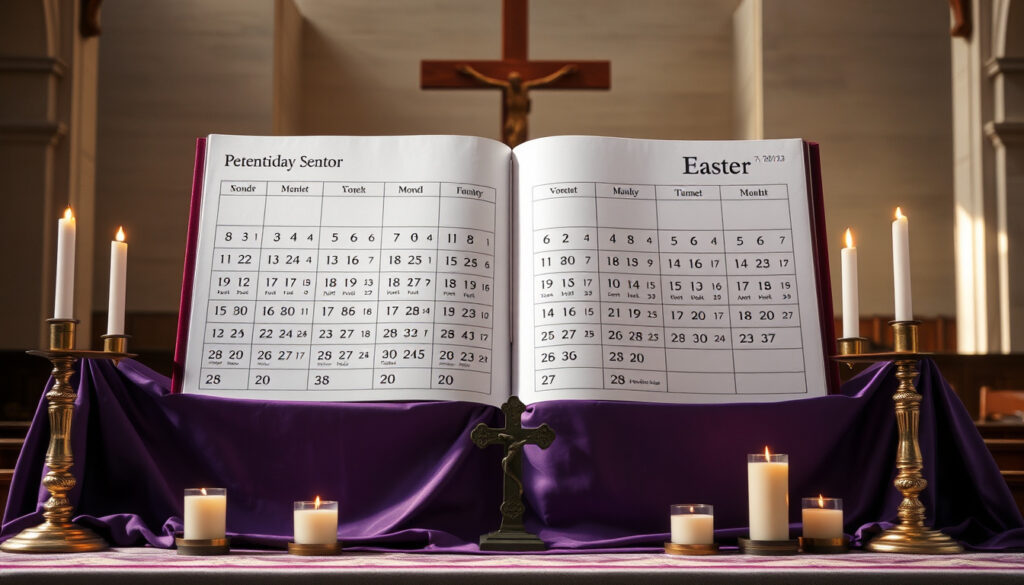
When Does Lent End? Catholic, Orthodox Dates Explained
Most people assume Lent ends on Easter Sunday—or at least on Good Friday. But if you’re counting days, the math doesn’t quite add up. Catholic Lent ends when Holy Thursday begins, which means your sacrifice technically stops two days before Easter arrives.
Western Lent length: 40 days · Ends on: Holy Thursday evening · 2026 end date: April 2 · Eastern Orthodox dates: Varies, later than Western · Triduum start: Mass of Lord’s Supper
Quick snapshot
- Lent ends at sundown on Holy Thursday with the Mass of the Lord’s Supper (St. Ignatius of Loyola Catholic Church)
- For Western Christians including Catholics, Lent ends on April 2, 2026 (Encyclopaedia Britannica)
- Catholic Lent lasts 40 days excluding Sundays (St. Ignatius of Loyola Catholic Church)
- Exact Orthodox Palm Sunday and Clean Monday dates for 2026 not specified in all sources
- Precise local sundown times vary by timezone and region
- Regional variations in non-Greek Orthodox jurisdictions
- Ash Wednesday: February 18, 2026 — Lent begins (Hallow)
- Holy Thursday: April 2, 2026 (sundown) — Lent ends (Encyclopaedia Britannica)
- Easter Sunday: April 5, 2026 — Triduum concludes (Hallow)
- Triduum begins: Holy Thursday evening through Easter Vigil (Encyclopaedia Britannica)
- Orthodox Pascha (Easter): April 12, 2026 (Encyclopaedia Britannica)
- Sacrifice stops after Holy Thursday Mass in Catholic tradition (St. Ignatius of Loyola Catholic Church)
This table compares key milestones between the two major Christian traditions observing Lent in 2026.
| Key milestone | Catholic / Western | Orthodox Eastern |
|---|---|---|
| Lent starts | Ash Wednesday, February 18, 2026 (Hallow) | Clean Monday, February 23, 2026 (Hallow) |
| Lent ends | Holy Thursday, April 2, 2026 (sundown) (Encyclopaedia Britannica) | Friday before Palm Sunday, April 3, 2026 (Encyclopaedia Britannica) |
| Easter / Pascha | April 5, 2026 (Hallow) | April 12, 2026 (Encyclopaedia Britannica) |
| Days counted | 40 (Sundays excluded) (St. Ignatius of Loyola Catholic Church) | 40 (Sundays included) (Holy Protection Orthodox Church) |
| Calendar used | Gregorian (Psalm 91) | Julian or Revised Julian (Psalm 91) |
Does Lent end on Good Friday or Easter Sunday?
No. Lent does not end on Good Friday or Easter Sunday in any major Christian tradition. It ends before Good Friday arrives—and the distinction matters because it’s tied to a specific liturgical moment: the Mass of the Lord’s Supper on Holy Thursday evening.
The Easter Triduum—Holy Thursday, Good Friday, Holy Saturday, and Easter Sunday—forms a separate, distinct liturgical period that overlaps with but technically follows the end of Lent. Think of it as the church transitioning from one season into another: Lent ends when the Triduum begins, not when Easter arrives.
Western Catholic tradition
In the Catholic tradition, Lent ends at sundown on Holy Thursday when the evening Mass of the Lord’s Supper begins, according to St. Ignatius of Loyola Catholic Church. The priest enters the church in procession, the bells are silenced, and the liturgical tone shifts entirely. This moment marks the formal conclusion of the 40-day season and the beginning of the three-day paschal observance that culminates in Easter.
Role of Holy Triduum
The Triduum—”three sacred days”—runs from the evening Mass of the Lord’s Supper through the Easter Vigil. During this period, the church treats these days as one extended liturgy. Encyclopaedia Britannica notes that for Western Christians, Lent ends on April 2, 2026, at sundown on Maundy Thursday, with Easter following three days later on April 5. The implication is clear: if you’re waiting for Easter to end your sacrifice, you’re holding on past the official boundary.
When does Lent end for Catholics?
Catholic Lent ends at the start of the Mass of the Lord’s Supper on Holy Thursday—which in 2026 means sundown on April 2. This is a precise moment, not a full day. The liturgical day in Catholic tradition runs from evening to evening, so when the priest begins the Holy Thursday evening service, Lent has concluded even though the church is still in the middle of Holy Week.
The 40-day count excludes Sundays because Sundays are mini-resurrection celebrations within Lent. That means the season spans roughly six and a half weeks from Ash Wednesday, not a strict 46-day calendar period. Hallow confirms that in 2026, Catholic Ash Wednesday falls on February 18, Palm Sunday on March 29, and Easter on April 5—placing Holy Thursday on April 2 at the terminus of the Lenten journey.
Exact timing: Mass of the Lord’s Supper
The precise moment is the beginning of the evening Mass, not the end of Holy Thursday or any other point. St. Ignatius of Loyola Catholic Church states that Lent ends with the start of the Mass of the Lord’s Supper. This means if your parish holds the service at 7 p.m., Lent ends at 7 p.m. Your sacrifice can technically stop then, though many parishes and individuals continue some form of observance through Holy Week as a matter of personal devotion rather than obligation.
2025 and future dates
The dates shift annually based on when Easter falls. For context, Holy Thursday in 2025 falls on April 17. In 2027, it will be April 15. The pattern follows the lunar-based calculation that determines Easter: the first Sunday after the first full moon after the spring equinox. What doesn’t change is the rule: Lent ends when the evening Mass of the Lord’s Supper begins, regardless of the calendar year.
For most Catholics in 2026, the green light to stop your sacrifice comes at sundown on April 2—not April 5. Check your parish bulletin or diocesan website for the exact start time of the Holy Thursday service to nail down your personal timeline.
When does Lent end Orthodox?
Eastern Orthodox Great Lent follows a different calendar and counting method, which means it ends on a different date than Catholic Lent—April 3, 2026, one day after the Western conclusion. The difference stems from calendar systems, counting methods, and theological traditions that have diverged over centuries.
In Eastern Orthodox churches, Great Lent formally ends on the Friday before Palm Sunday, according to Encyclopaedia Britannica. This is a distinct cutoff from the Catholic Holy Thursday tradition, and it creates a scenario where Western and Eastern Christians finish their Lenten observances on separate days—sometimes by a week or more, depending on the year.
Eastern vs Western calendars
Orthodox churches typically operate on the Julian or Revised Julian calendar rather than the Gregorian calendar used by Western Christianity. This discrepancy means Orthodox Easter and Lent often fall on different dates than their Western counterparts. In 2026, Orthodox Pascha falls on April 12—fully a week after Catholic Easter on April 5, according to Encyclopaedia Britannica.
Psalm 91 notes that Orthodox churches often use Julian or Revised Julian calendars, leading Easter (and Lent’s start) to fall typically a week after Western dates. This isn’t merely a scheduling quirk—it reflects fundamentally different astronomical calculations that trace back to the Council of Nicaea in 325 AD and subsequent historical schisms.
Orthodox Great Lent duration
Great Lent begins on Clean Monday—the Monday before Orthodox Lent starts—as confirmed by Hallow. Orthodox Great Lent 2026 begins on Monday, February 23. Unlike Catholic practice, Orthodox Lent includes Sundays in its 40-day count. Holy Protection Orthodox Church states that Great Lent extends from Clean Monday until the Friday before Palm Sunday.
According to Wikipedia, Great Lent begins on Clean Monday, seven weeks before Pascha, and lasts 40 continuous days including Sundays, ending on Friday of the Sixth Week. The church counts all seven days each week, meaning the fasting discipline applies every day—not just on weekdays with Sunday reprieves like in Catholic practice.
The gap between Western and Eastern end dates isn’t arbitrary—it’s the result of two different approaches to counting 40 days. Catholics exclude six Sundays (treating them as interruptions), while Orthodox include all 40 days in sequence. When you add the calendar difference, Western and Orthodox Lent can end anywhere from one day to five weeks apart depending on the year.
When can I stop my Lent sacrifice?
In Catholic practice, you can stop your Lent sacrifice after the Mass of the Lord’s Supper on Holy Thursday begins—that’s the official end of Lent and the start of the Triduum. For 2026, that means sundown on April 2. You’re not obligated to continue through Good Friday or Easter Sunday as part of the Lenten season.
That said, many Catholics choose to maintain some form of sacrifice or discipline through Holy Week as a personal devotional practice. This isn’t required by church law, but it’s a common pastoral recommendation. The church distinguishes between the formal end of Lent (Holy Thursday evening) and the ongoing spiritual discipline of personal sacrifice during the holiest week of the year.
After Holy Thursday Mass
Once Holy Thursday evening arrives and the Mass of the Lord’s Supper begins, the formal Lenten season has concluded. St. Ignatius of Loyola Catholic Church defines Lent as a 40-day season of prayer, fasting, and almsgiving preparing for the Easter Resurrection—and that preparation ends when the celebration begins.
If your parish has multiple Mass times on Holy Thursday, the earliest service time typically marks the beginning of the Triduum. Some parishes hold the Mass of the Lord’s Supper in the evening only, which means Lent ends when that service starts—regardless of when you personally attend.
Reddit community views
Online discussions among Catholics confirm that the consensus is Holy Thursday evening, though some express uncertainty about whether the sacrifice should extend through the entire Triduum. The key distinction that emerges from lay discussions is between the legal definition (Lent ends Holy Thursday) and the pastoral reality (many people continue some form of sacrifice through Holy Week as a personal choice). This gap between rule and practice is normal and reflects the balance between obligation and devotion.
What is the 3:1:1 rule for Lent?
The 3:1:1 rule is a common framework for understanding Lenten fasting obligations, though it’s not an official church law—it’s more of a pastoral shorthand. The pattern breaks down as: three days of full fasting (or substantial restriction), one day of partial fasting, and one day with no obligation. The specifics depend on your tradition and local bishop’s guidance.
For Catholics in the United States and many Western countries, the universal Church law specifies only two days of fasting: Ash Wednesday and Good Friday. Beyond that, local bishops or national conferences may add additional days or specify the nature of the fast. The 3:1:1 pattern reflects a traditional approach where people fasting more strictly might observe three “lean” days, one moderate day, and one free day per week—but this flexibility varies widely.
Interpreting the rule
The rule emerges from historical practice before the current norms. In eras when fasting was more universal and rigorous, people might structure their week: Monday, Wednesday, Friday as strict fast days; Tuesday and Thursday as partial restriction; Saturday as free; Sunday as celebration. St. Mary Orthodox Church notes that Orthodox fasting during Great Lent prohibits meat, fish (except shellfish), eggs, cheese, dairy, alcohol, and olive oil on weekdays—a far stricter interpretation than Catholic norms.
Common practices
Today’s Catholic observance typically focuses on meatless Fridays during Lent as the primary rule, with Ash Wednesday and Good Friday as days of fasting (one main meal, two smaller meals, no eating between). The 3:1:1 framework, if used, would be a personal discipline structure rather than a mandate. The Tablet reports that 79% of practicing Catholics fast from food or drink during Lent, compared to 85% of Orthodox believers and 57% of Anglicans—showing that the level of observance varies significantly by tradition.
Lent Timeline
What We Know vs What’s Unclear
Confirmed
- Catholic Lent ends at Mass of the Lord’s Supper on Holy Thursday evening
- 2026 Catholic Lent ends April 2 at sundown
- Catholic Lent is 40 days excluding Sundays
- Orthodox Great Lent ends April 3, 2026
- Orthodox Great Lent begins February 23, 2026
- Calendar difference causes Orthodox dates to fall later
- 79% of Catholics and 85% of Orthodox fast during Lent (The Tablet)
What’s unclear
- Exact Orthodox Palm Sunday date for 2026 in all sources
- Regional variations in non-Greek Orthodox jurisdictions
- Precise local sundown times by timezone
- How widely the 3:1:1 rule is actually practiced today
What the Sources Say
Lent ends with the start of the Mass of the Lord’s Supper on Holy Thursday.
For Western Christians, Lent ends on April 2, 2026, with Easter on April 5.
In Eastern Orthodox churches, Great Lent formally ends on the Friday before Palm Sunday.
Great Lent extends from Clean Monday until the Friday before Palm Sunday.
Summary
The ending of Lent is not a single moment across Christianity—it’s a split picture. Western Catholics exit Lent on Holy Thursday evening (April 2 in 2026) while Orthodox Christians conclude their Great Lent one day later (April 3). The discrepancy traces to calendar differences and counting methods: Catholics exclude Sundays from the 40-day tally while Orthodox include all seven days, and Orthodox churches often follow Julian or Revised Julian calendars that place Easter a week after the Western date. The practical implication for anyone observing Lent in 2026: if you’re Catholic, your sacrifice technically stops at sundown on Holy Thursday (April 2); if you follow Orthodox tradition, you continue until April 3. Either way, waiting until Easter Sunday means you’ve already overshot the official end by at least a day. The Easter Triduum—Holy Thursday through Easter—is its own liturgical season, not an extension of Lent, which means the window for your sacrifice closes earlier than many assume.
Related reading: Baradene College of the Sacred Heart · Baradene College of the Sacred Heart
Catholics typically end Lent on Holy Thursday evening, while Orthodox fasting concludes shortly before Orthodox Easter 2026 on April 12.
Frequently asked questions
When does Lent end for Anglicans?
Anglican practice generally follows the Western Catholic tradition, meaning Lent ends at the beginning of the Maundy Thursday (Holy Thursday) evening service. However, specific Anglican provinces and individual dioceses may have slight variations in their liturgical calendars. The core timing aligns with the Catholic pattern, with Ash Wednesday as the start and Holy Thursday evening as the conclusion.
When does Lent end how many days?
Catholic Lent runs 40 days if you count only the fasting days (excluding Sundays), which spans 46 calendar days from Ash Wednesday to Holy Thursday. Orthodox Great Lent is also 40 days, but includes all seven days of each week, meaning the period is 40 consecutive days without interruption. The counting method differs, but the target is the same: 40 days of preparation.
Is Friday a cheat day for Lent?
No. Friday remains a day of abstinence in Catholic tradition throughout Lent—you’re expected to abstain from meat on all Fridays during the season. However, some local conferences of bishops have relaxed the Friday meat prohibition in certain countries, replacing it with another form of penance or charity. The “cheat day” concept has no basis in official church law, though personal discipline structures (like the 3:1:1 rule) may allow flexibility in non-obligatory areas.
When does Lent start and end?
Catholic Lent starts on Ash Wednesday (February 18 in 2026) and ends at the beginning of the Mass of the Lord’s Supper on Holy Thursday (April 2, 2026, at sundown). Orthodox Great Lent begins on Clean Monday (February 23, 2026) and ends on the Friday before Palm Sunday (April 3, 2026). The dates shift annually based on when Easter falls.
Does Lent end on Easter?
No. Lent ends before Easter arrives. In Catholic practice, Lent ends at the start of Holy Thursday evening, which is still two full days before Easter Sunday. Easter marks the conclusion of the Triduum, a separate liturgical period. Observers who wait until Easter Sunday to end their sacrifice are finishing past the official deadline.
When does lent end on thursday?
Lent ends at the beginning of the Mass of the Lord’s Supper on Holy Thursday—not at the end of the day or at midnight. The liturgical day in Catholic tradition runs from evening to evening, so when the priest begins the Thursday evening service, Lent has concluded. For 2026, this means Lent ends at whatever time your parish schedules the Holy Thursday service.
What happens after Lent ends?
After Lent ends, the Easter Triduum begins—Holy Thursday evening through Easter Sunday. This is the most solemn period in the Christian calendar, commemorating Jesus’s Last Supper, crucifixion, burial, and resurrection. Fasting obligations during the Triduum are separate from Lenten obligations. After Easter, the 50-day Easter season begins, running from Easter Sunday through Pentecost.
More related posts
 English to Māori Translator: Guide to Te Reo Tools
 Airport Lounge Access Without Koru Membership: 2026 Guide
 Christchurch to Wellington Flights: Direct & Cheap Fares
 What Is the No Kings Protest? 8M Turnout in 3 Major Waves
 Palmerston North Death Notices: Latest & How to Search
 Yankees vs Blue Jays 2026: ALDS History & Season Series
 Joseph Gordon-Levitt: Career, Life & HitRecord Update
 How Much Can I Borrow NZ – 2025 Mortgage Calculator Guide