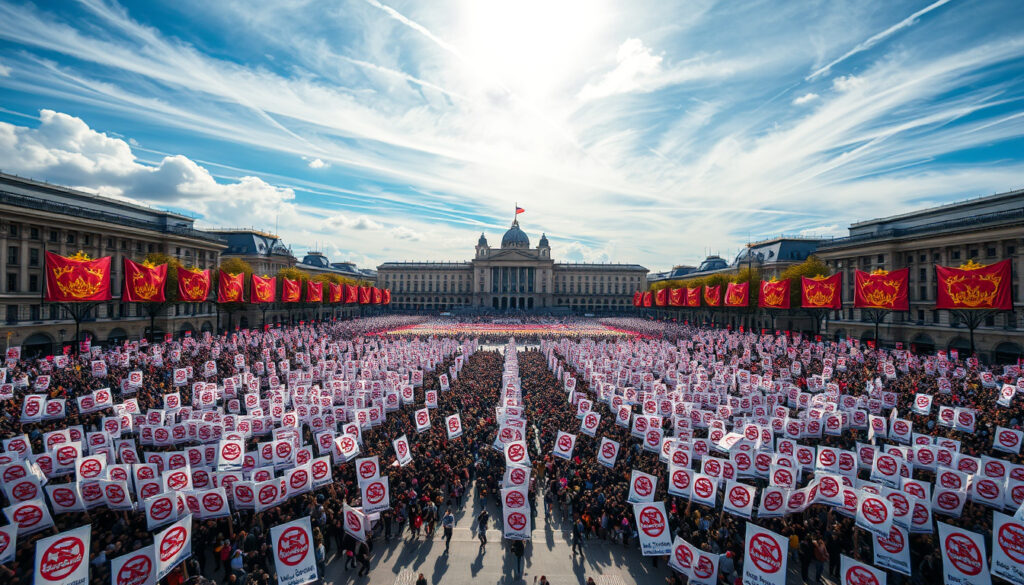
What Is the No Kings Protest? 8M Turnout in 3 Major Waves
By the time Trump’s second term reached its first anniversary, millions of Americans had already taken to the streets three times. The No Kings protests began as a single-day act of defiance on his birthday—then kept going. What started as coordinated rallies have since grown into one of the largest sustained mobilizations in modern U.S. history, with turnout estimates ranging from 5 million to 8 million across thousands of locations.
Major Rallies: 3 ·
Peak Turnout: 8 million people ·
Protest Locations: 3,300 sites ·
Start Date: June 2025 ·
Trigger Event: Trump’s birthday
Quick snapshot
- Three protest waves since June 2025 (Britannica)
- Attendance climbed from 5M to 8M across waves (Center for American Progress)
- Exact impact on long-term policy changes
- Demographics of protester affiliations
- Details on fourth wave planning
- June 14, 2025: First protest on Trump’s birthday
- Oct. 18, 2025: Second wave at 2,700 sites
- March 28, 2026: Third rally hits 3,300 locations
- Movement targets 3.5% population threshold for concessions
- Grassroots groups organizing for continued pressure
Key protest metrics show steady escalation across three major waves of No Kings mobilizations.
| Detail | Data |
|---|---|
| First Protest Date | June 14, 2025 |
| Organizing Site | NoKings.org |
| Peak Attendance | 8 million |
| Rally Count | 3 major |
| Second Event | October 18, 2025 |
| Third Event | March 28, 2026 |
| First Wave Sites | 2,100 locations |
| Second Wave Sites | 2,700 locations |
| Third Wave Sites | 3,300 locations |
What is a No Kings protest all about?
The No Kings movement is a series of coordinated, non-violent protests against Donald Trump’s second presidential term. Organizers chose the name to signal that American democracy does not answer to any single ruler—and that policies perceived as authoritarian deserve resistance. The protests spread from small towns to city centers, drawing participation across the political spectrum while exercising First Amendment rights.
Origins
No Kings protests launched on June 14, 2025, when Trump turned 79. That same day, the U.S. Army celebrated its 250th anniversary with a military parade in Washington D.C.—an event that became a backdrop for the first rallies. According to Britannica, the movement began as a single-day act of defiance tied directly to the president’s birthday, then evolved into recurring nationwide campaigns.
Core Message
The slogan “America has No Kings” anchors the movement’s message. Organizers argue that immigration crackdowns, executive overreach, and policies perceived as antidemocratic fall outside the bounds of legitimate governance. The Center for American Progress notes that protests demanded end to the Iran war, military and ICE deployment in cities, and accountability for enforcement abuses.
What this means: The movement has evolved from symbolic birthday defiance into a sustained campaign targeting specific policy failures under the second Trump administration.
The protests operate on a theory of change borrowed from Harvard professor Erica Chenoweth’s research: when 3.5% of a nation’s population engages in sustained, peaceful mobilization, governments face pressure to negotiate. Current attendance at 8 million represents roughly 2.4% of the U.S. population—still below the theoretical threshold but climbing.
Why is it called No Kings protest?
The name “No Kings” is a direct challenge to what organizers describe as Trump’s increasingly authoritarian approach to governance. It draws on constitutional language, positioning the movement as a defender of democratic norms rather than a partisan attack. The framing resonates across different political persuasions, making the protests inclusive rather than tied to any single ideology.
Slogan Meaning
“America has No Kings” means that no elected official—regardless of office—stands above the Constitution or public accountability. Business Today reports that the slogan targets Trump’s policies on immigration enforcement, the Iran war, and perceived suppression of information like the Epstein files. The message is broad enough to attract anyone alarmed by executive power concentration.
Historical Context
Protests with similar naming conventions spread internationally. In constitutional monarchies like the United Kingdom, rallies adopted the labels “No Tyrants” or “No Dictators” while retaining the anti-Trump theme. This international reach, documented by Britannica, shows how the movement’s framing connects to broader global debates about democratic backsliding and executive authority.
The implication: The anti-monarchical framing has allowed the movement to transcend traditional partisan boundaries, attracting protesters who may disagree on other issues but unite around constitutional principles.
What is the reason behind the protest?
Each wave of No Kings protests was triggered by specific policy developments under the second Trump administration. Wikipedia reports that the March 2026 rally was driven by U.S. involvement in the Iran war, immigration enforcement deaths, ICE operations, and concerns over democratic backsliding. These concrete grievances—not abstract ideology—mobilized millions onto the streets.
Trump Policies
Organizers point to multiple administration actions as justification for resistance. The Iran conflict, stretching into its fourth week by March 2026 per Business Today, fueled particularly sharp turnout. Immigration enforcement tactics drew separate outrage, especially after deaths linked to ICE operations during enforcement actions.
Key Triggers
The deaths of Alex Pretti and Renée Good during enforcement operations, along with a Minnesota general strike in early 2026, prompted the third protest announcement. These events galvanized supporters who saw them as evidence of federal overreach warranting immediate response.
What this means: The movement responds to measurable policy harms rather than political disagreement, framing resistance in terms of documented consequences.
Minnesota activists can claim a concrete win: sustained mobilizations in early 2026 forced the Trump administration to reduce ICE and federal agents in the state. The Center for American Progress documents this as the clearest example of protests producing near-term policy concessions—proof that organizers cite when arguing continued pressure works.
Who is behind the No Kings movement?
NoKings.org serves as the primary organizing hub for the movement, providing coordination tools, event registration, and messaging guidance for local groups. The site describes the movement as a grassroots effort that grew from single-day rallies into a sustained campaign against authoritarian power.
Grassroots Groups
Beyond the central website, local organizers in cities and towns across all 50 states drive day-to-day mobilization. NoKings.org claims the movement evolved from small-town resistance to city-center activism—a pattern visible in the geographic spread of events from 2,100 sites in June 2025 to 3,300 by March 2026.
Key Figures
While no single figure dominates the movement, organizers frame their mission around constitutional principles rather than partisan loyalty. The movement’s decentralized structure means power diffuses across thousands of local leaders rather than concentrating in a national spokesperson.
The pattern: This decentralized approach has enabled rapid geographic expansion while making the movement resistant to disruption through targeting any individual leader.
How many No Kings protests have there been?
Three major protest waves have occurred since June 2025, with attendance and geographic reach climbing with each rally. Britannica confirms the first event drew over 5 million people at approximately 2,100 sites, while the Center for American Progress documents the October 2025 second wave at 2,700 locations with roughly 7 million participants.
Major Events
The third wave on March 28, 2026, marked the movement’s peak, with estimates of 8 million participants across 3,300 cities and towns in all 50 states. The Telegraph describes it as one of the largest mobilizations in modern U.S. history, while NBC News predicted it would become the single largest non-violent day of action in American history.
Turnout Numbers
Attendance estimates show steady growth: 5 million in June 2025, 7 million in October 2025, and 8 million in March 2026. NoKings.org claims the October 2025 protests were 14 times larger than both Trump inauguration ceremonies combined. Protests spanned major cities including New York and Los Angeles down to smaller towns, both domestically and internationally.
The catch: Attendance figures come from organizer estimates rather than independent verification. While multiple outlets report similar numbers, independent counters have not confirmed exact totals—and the research gap leaves room for debate about precise scale.
Attendance figures come from organizer estimates rather than independent verification. While multiple outlets report similar numbers, independent counters have not confirmed exact totals—and the research gap leaves room for debate about precise scale.
Timeline
- June 14, 2025: First No Kings protests launch on Trump’s birthday, coinciding with military parade in Washington D.C. (Britannica encyclopedic record)
- October 18, 2025: Second major rally day with estimated 7 million participants across 2,700 locations in all 50 states (No Kings official site)
- January 2026: Announcement of third protests following deaths during enforcement operations and Minnesota general strike (Wikipedia entry)
- Early 2026: Minnesota mobilizations force Trump administration to reduce ICE and federal agents in the state (Center for American Progress policy analysis)
- March 28, 2026: Third No Kings protests involve estimated 8 million participants across 3,300 cities and towns in all 50 states (Center for American Progress policy analysis)
Confirmed
- Three protest waves since June 2025
- Attendance climbed from 5M to 8M across waves
- Protests largely peaceful with some city clashes
- Movement exercised First Amendment rights
- Minnesota pressure led to ICE reduction
- Grassroots resistance spread from towns to cities
Unclear
- Exact attendance from independent counters
- International protest scale and locations
- Post-March 2026 developments or fourth waves
- Official government concession details beyond Minnesota
- Demographics and political affiliations of protesters
What people are saying
America has No Kings.
— No Kings organizers (No Kings official site)
When 3.5 percent of a nation’s population peacefully mobilizes and sustains itself at key moments, the government can be forced to meet their demands.
— Erica Chenoweth, Harvard professor (via Center for American Progress)
Thousands of demonstrations are planned in all 50 states in the third round of ‚No Kings’ protests… the “single largest non-violent day of action” in American history.
— Steven Romo, NBC News reporter (NBC News media coverage)
Related reading: How Much Can I Borrow NZ · Westpac Home Loan Rates
The movement quickly spread abroad, manifesting as No Kings Day protests in Amsterdam No Kings Day in Amsterdam where crowds rallied against Trump’s policies.
Frequently asked questions
When is the next No Kings protest 2026?
No formal fourth-wave announcement had been made at time of publication. Organizers continue operating through NoKings.org, and local groups may schedule events based on policy developments.
Did the No Kings protest do anything?
Minnesota mobilizations in early 2026 directly forced the Trump administration to reduce ICE and federal agents in the state. This concrete win, documented by the Center for American Progress, is the movement’s clearest documented impact to date.
Why are protests going on against Trump?
Protests have targeted multiple policies including U.S. involvement in the Iran war, immigration enforcement tactics, executive overreach, and concerns over democratic institutions. The specific triggers have varied between each rally wave.
What is the purpose of a protest?
The No Kings movement operates on research suggesting that sustained mass mobilization can pressure governments to negotiate or concede. Organizers explicitly cite the 3.5% mobilization threshold from Harvard professor Erica Chenoweth’s work as their benchmark for success.
Why are Gen Z protesting?
While demographic breakdowns vary, multiple reports note young participants drawn by concerns over immigration enforcement, the Iran war, and democratic backsliding. Economic pressures including rising living costs also factor into broader anti-establishment sentiment.
More related posts
 Air New Zealand Store: Airpoints Shop Online Guide
 Public Holidays New Zealand 2026: Dates, Leave & 92-Day Rule
 Jobs in Auckland New Zealand: No Exp, Part-Time & Foreigners
 I Hawaii Five-0 Coming Back in 2026? Cancellation, Ca t & More
 Westpac Home Loan Rates – Current NZ Special and Standard Rates
 225 USD to NZD – Convert US Dollars to New Zealand Dollars
 South Island Heavy Rain and Snow: Warnings & Forecast
 Pak n Save Tauranga: Hours, Specials & Ownership