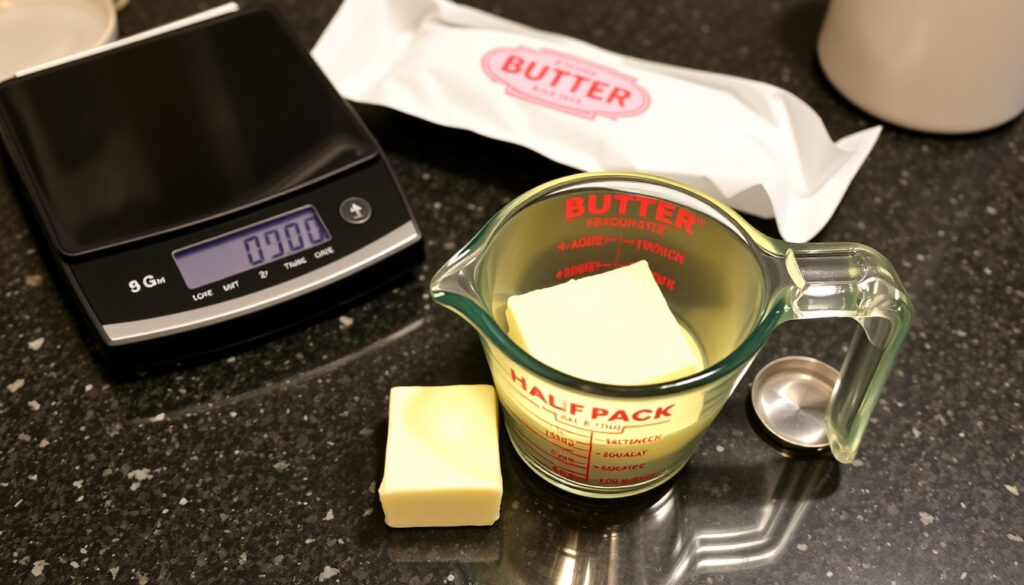
Half Cup Butter in Grams: Quick Conversion Guide
Few things throw off a baking session faster than staring at an unfamiliar measuring cup and wondering how many grams that half-stick of butter actually weighs. The truth is, whether you should use 113 grams or 125 grams depends entirely on where that recipe came from. Here’s exactly how to decode the number and get your bake right every time.
US standard 1/2 cup butter: 113 grams ·
Metric standard 1/2 cup butter: 125 grams ·
Butter stick equivalent: 1 stick (4 oz, 8 tbsp) ·
Tablespoons in 1/2 cup: 8 tbsp
Quick snapshot
- 0.5 cup US butter = 113.4 grams (rounded to 113 g) (Traditional Oven butter converter)
- 1 stick of butter = 0.5 cup = 8 tbsp = ~113 g (Erren’s Kitchen baking conversion guide)
- Salted and unsalted butter weigh the same (Baking Like a Chef butter conversion chart)
- Which conversion (113 g or 125 g) a specific recipe author intended to use
- Whether a Canadian or Australian recipe uses the metric cup (250 ml) or the US cup (240 ml) base
- Butter measurement conversions have been standardized in US baking for decades; the 113 g figure is consistent across modern conversion charts
- When in doubt, use 113 g for US recipes and 125 g for metric recipes — and always check the recipe’s country of origin first
What is 1/2 cup butter in grams?
How many grams is half a cup of butter?
- US standard measure: 0.5 cup of butter = 113.4 grams (commonly rounded to 113 g). This is based on the US-defined cup of 240 ml and the specific density of butter. (Inch Calculator butter weight converter)
- Metric / Canadian measure: 0.5 cup of butter = 125 grams. Some Canadian guides list 0.5 cup at 115 g, using a rounded metric-style conversion. (Dairy Farmers of Canada Canadian dairy authority)
- Australian measure: 0.5 cup of butter = 125 grams (Australia uses the metric cup of 250 ml). (Taste.com.au Australian recipe platform)
The pattern is clear: the divergence comes from the cup size, not the butter itself. The US cup is 240 ml; the metric cup used in Australia and much of Europe is 250 ml. That 10 ml difference (about 4%) is the exact gap between the 113 g and 125 g figures.
The implication: a baker using a US family recipe but living in the UK who automatically reaches for 125 g will add roughly 10% more butter to the mix.
Over several batches of cookies, that difference shifts the spread, texture, and crumb structure noticeably.
How much is 1 cup of butter in grams?
How many grams in 1/4 cup butter?
- 0.25 cup US butter = 56.7 grams (commonly 57 g) (Good Cooking conversion tables)
- 0.25 cup metric butter = 62.5 grams
How many grams in 3/4 cup butter?
- 0.75 cup US butter = 170.1 grams (commonly 170 g)
- 0.75 cup metric butter = 187.5 grams
Three common cup amounts, one consistent ratio: multiply the US cup value by 0.473 for grams (since butter density is 0.959 g/ml × 240 ml = 227 g per cup, half that is 113.5 g). For metric, multiply by 0.5 (since 250 ml × 0.959 g/ml ≈ 240 g per cup, half is 120 g — though most metric sources round to 125 g for simplicity).
The pattern: seven cup amounts, one ratio — the US-to-gram relationship stays constant, but the metric equivalent shifts exactly by the cup volume difference.
| Cup amount | US → grams | Metric → grams |
|---|---|---|
| 0.25 cup | 57 g | 62.5 g |
| 0.33 cup | 76 g | 83 g |
| 0.5 cup | 113 g | 125 g |
| 0.66 cup | 151 g | 166 g |
| 0.75 cup | 170 g | 187.5 g |
| 1 cup | 227 g | 250 g |
What this means: if you are following a recipe from an American blog, use the US column. If the recipe came from Australia, the UK, or uses weight-only measurements, use the metric column. Mixing them up means shifting the butter content by roughly 10% per cup.
The catch: a European baker who adapts a US cookie recipe using metric cups will add 23 extra grams of butter per cup (250 g vs 227 g).
That’s enough to turn a crisp cookie into a flat, greasy one — and the baker may never diagnose why.
How do you measure ingredients like butter in cups?
How to measure butter without a kitchen scale
- Use the stick markings: US butter is sold in sticks with tablespoon markings printed on the wrapper. One stick = 0.5 cup = 8 tbsp = ~113 g. (Erren’s Kitchen butter measurement guide)
- Water displacement method: For solid butter from a block, fill a measuring cup with water to the 1 cup mark. Add butter until the water level reaches the desired volume (e.g., to get 0.5 cup of butter, add butter until water rises to 1.5 cups). Drain water — the butter is measured. (Dairy Farmers of Canada measurement guide)
Using butter stick markings
- Each stick of butter in the US has lines at the tablespoon, 0.25-cup, and 0.5-cup marks.
- Cut at the 0.5-cup line for exactly 113 g.
- Standard US butter packaging: four sticks per pound, each stick ~113 g. (Erren’s Kitchen stick packaging info)
The trade-off: stick markings are the easiest method for US bakers, but they are useless for international readers. The water displacement method works universally, though it requires a bit more cleanup.
For the baker who owns a kitchen scale, the problem disappears entirely. Weighing butter in grams eliminates all cup-size ambiguity and is the single most reliable method for consistent baking results across any recipe origin.
Clarity section
Confirmed facts
- 0.5 cup US butter = 113 g — confirmed by multiple conversion charts and the direct US cup standard. (Traditional Oven)
- 1 stick = 0.5 cup = 8 tbsp = ~113 g — consistent across all US butter packaging and conversion guides. (Erren’s Kitchen)
- Salted and unsalted butter weigh the same — salt content is too small to affect mass meaningfully. (Baking Like a Chef)
- 1 cup butter = 227 g (US) or 250 g (metric) — the doubling relationship holds exactly. (Industry Kitchens commercial kitchen supplier)
What’s unclear
- Which conversion a specific recipe author uses — many recipe blogs do not state whether they follow US or metric cup definitions.
- Whether Canadian or Australian recipes use the metric cup (250 ml) or the US cup (240 ml) — some Canadian sources round to 115 g instead of 125 g or 113 g.
Quotes from sources
“In US measurements, 1/2 cup of butter is equal to 113.4 grams.”
“A common rounded baking conversion lists 1/2 cup of butter as 113 grams.”
“Some Canadian guidance rounds 1/2 cup of butter to 115 grams rather than 113 grams.”
“A Canadian kitchen guide states that 1/2 cup of butter is 115 g and also 1/4 block, 8 tbsp, or 125 mL.”
Summary
The confusion around half a cup of butter in grams comes down to one thing: the cup itself. A US cup is 240 ml, a metric cup is 250 ml, and that 10 ml difference produces a 12-gram gap between 113 g and 125 g. For the home baker following a cross-border recipe, the fix is simple: look up the recipe’s origin, pick the corresponding column from the table above, and weigh your butter on a kitchen scale. That habit eliminates guesswork and ensures your cookies spread exactly as the author intended.
Related reading: butter conversion chart · butter measurement weight conversions
thecoastalitalian.com, eatlittlebird.com, instagram.com, reddit.com, dairyfarmersofcanada.ca
For a thorough breakdown of how half cup butter in grams aligns across different measuring systems, see this half cup butter to grams conversion guide.
Frequently asked questions
Is 250g of butter half a cup?
No. 250 g is roughly equivalent to 1 metric cup of butter, not half a cup. Half a cup in metric is 125 g; in US measurements, half a cup is 113 g.
Is 100 grams of butter half a cup?
No. 100 g is slightly less than half a cup. In US measurements, half a cup is 113 g; in metric, half a cup is 125 g. 100 g is about 7 tablespoons of butter.
How many sticks of butter make 1/2 cup?
One stick of US butter equals exactly 0.5 cup, 8 tablespoons, and approximately 113 grams.
What is the weight of 1/2 cup of salted vs unsalted butter?
Salted and unsalted butter weigh the same. The salt content is negligible in terms of mass, so use the same conversion (113 g for US, 125 g for metric) for both.
Can I use margarine in the same weight as butter?
Yes. Margarine and butter have very similar densities, so you can substitute them weight-for-weight in most recipes. However, margarine may behave differently at high temperatures due to its different fat composition.
How do I convert 3/4 cup butter to grams?
For US measurements: 0.75 cup = 170 g. For metric: 0.75 cup = 187.5 g. This is simply 1.5 times the half-cup value.
What is 1/2 cup butter in ounces?
0.5 cup of butter is 4 ounces (US) or 4.4 ounces (metric). This is because 1 US cup = 8 oz, so half a cup = 4 oz.
How many tablespoons are in half a cup of butter?
There are 8 tablespoons in 0.5 cup of butter. Each tablespoon weighs approximately 14 grams.
More related posts
 Zoe and Morgan Earrings – Gold Materials Prices and Value Guide
 Best Moisturizer for Oily Skin: Expert Picks & Guide
 New Zealand Weather Cold Snap: March 2026 Forecast
 Kāwhia Highway Cut Off – SH31 Status and Access Guide
 Farmer Wants a Wife 2026: Still Together, Scare & Where to Watch
 Yankees vs Blue Jays 2026: ALDS History & Season Series
 Royal Heights Rest Home: Massey Auckland Care Guide & Reviews